Elderberry Syrup and Immune Support: What the Research Says
Every autumn, elderberry syrup shows up in health food shops, farmers’ markets, and kitchen cupboards across the country, usually with a label promising it will “boost immunity” or “fight off colds”. It’s one of the most talked-about herbal remedies for cold and flu season, and it’s also one of the most oversold.
Before you reach for a spoonful, or start simmering a batch on your own hob, it’s worth understanding what the research on elderberry actually shows, where the evidence runs thin, and who should be cautious about using it at all.
As an Amazon Associate I earn from qualifying purchases and sometimes recommend products from other sellers at no extra cost to you. For more details see my disclosure policy and privacy policy.
🔬 What Does the Research Actually Say?
The honest answer is: something, but not as much as the marketing suggests. A handful of small clinical trials have looked at elderberry extract and cold or flu symptoms, and the results are genuinely interesting, just not conclusive.
Forged & Grown — The Shop
Handpicked products chosen to fit the way we cook, grow, and create. Nothing generic — every item earns its place.
Visit the Shop


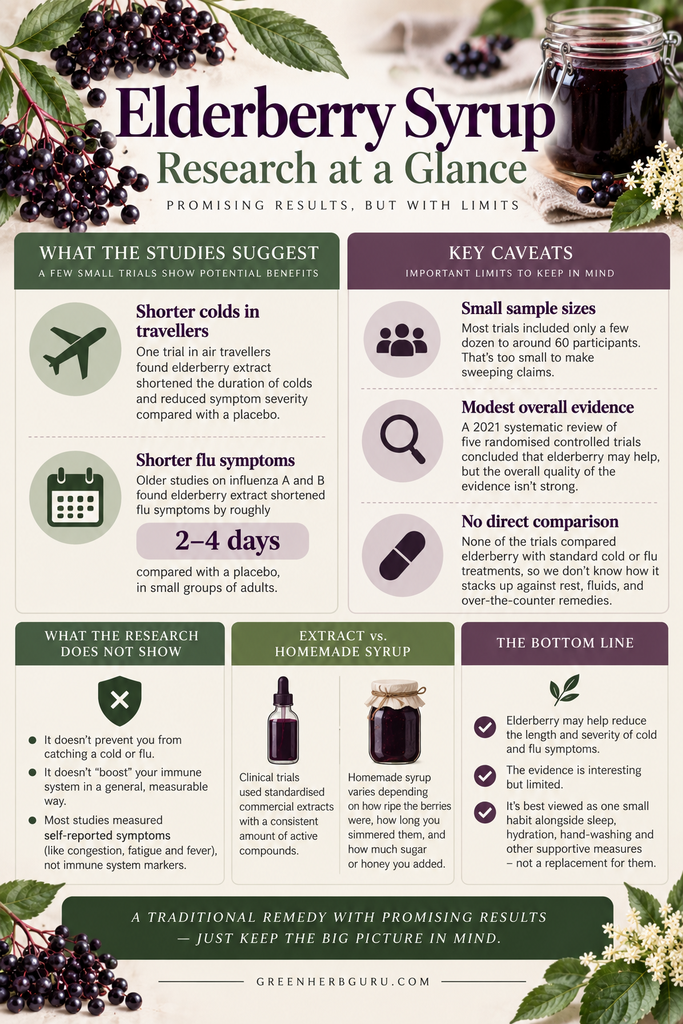
One frequently cited trial gave elderberry extract to air travellers and found it shortened cold duration and reduced symptom severity compared with a placebo. Older studies on influenza A and B found elderberry extract shortened flu symptoms by roughly four days compared with placebo, in small groups of adults.
A 2021 systematic review pooling five randomised controlled trials came to a more cautious conclusion. Elderberry may help, but the overall quality of the evidence isn’t strong. Sample sizes across these trials range from a few dozen to around 60 participants, far too small to make sweeping claims. None of the available trials compared elderberry against standard cold or flu treatments, so we don’t know how it stacks up against rest, fluids, and over-the-counter remedies.
What the research does not show is that elderberry prevents you from catching a cold or flu in the first place, or that it “boosts” your immune system in any measurable, general sense. Claims along those lines go beyond what the studies have actually tested.
It’s also worth noticing what these trials actually measured. Most tracked self-reported symptom scores such as congestion, fatigue, and fever, rather than blood markers of immune activity. That’s a reasonable way to test whether something makes a cold feel shorter or milder, but it’s a different question entirely from whether elderberry does anything measurable to how your immune system functions day to day. Marketing that leans on the word “immune-boosting” is usually blurring that distinction.
If you want more general herb options for the same season, our guide to herbal teas for immune support rounds up other options with a similarly cautious eye on the evidence.
🧪 Extract vs. Homemade Syrup: Why the Gap Matters
Here’s a detail that often gets lost when elderberry syrup recipes go viral: almost every clinical trial used a standardised commercial extract, not a homemade syrup simmered on the stove.
Standardised extracts are processed to contain a consistent, measured amount of active compounds, mainly anthocyanins, batch after batch. Homemade syrup varies depending on how ripe your berries were, how long you simmered them, and how much sugar or honey you added. That doesn’t mean homemade syrup does nothing, but it does mean the research on standardised extract can’t be assumed to apply, dose for dose, to a jar made in your own kitchen.
This is one of those “we genuinely don’t know” gaps in herbal research. It’s the same pattern we’ve seen with other well-studied herbs, like rosemary for focus, circulation and everyday wellness, where lab and clinical results don’t always translate cleanly to a home preparation.
If you’re new to using herbs this way, our beginner’s guide to everyday medicinal herbs you can grow in pots is a useful starting point before going further into any single-herb remedy.
🧺 Where Elderberry Fits Into a Realistic Cold-Season Routine
Given the limits of the evidence, it’s worth thinking about elderberry syrup as one small habit among many, rather than a stand-in for the basics.
Sleep, hydration, and hand-washing still do more for how often you catch a cold and how quickly you recover than any single herbal remedy, elderberry included. If you’re already doing those things and want to add a herbal habit on top, elderberry syrup is a reasonable, low-risk choice for most healthy adults, taken alongside the rest of your routine rather than instead of it.
This is also a good moment to think about variety rather than relying on one herb alone. Rotating in other cold-season herbs, such as the ones covered in our herbal teas for immune support roundup, spreads your bets across a wider range of traditional and lightly-studied options, none of which should be expected to replace basic self-care or medical advice when you’re genuinely unwell.
⚠️ Safety First: Who Should Be Cautious
This is the section we won’t skip, no matter how popular elderberry syrup is.
Raw and unripe elderberries, along with the leaves, stems, and seeds, contain compounds that release cyanide when eaten and are genuinely toxic. Elderberries must be fully ripe and properly cooked before eating or drinking in any form. Never eat elderberries straight off the plant, and never use green or unripe fruit.
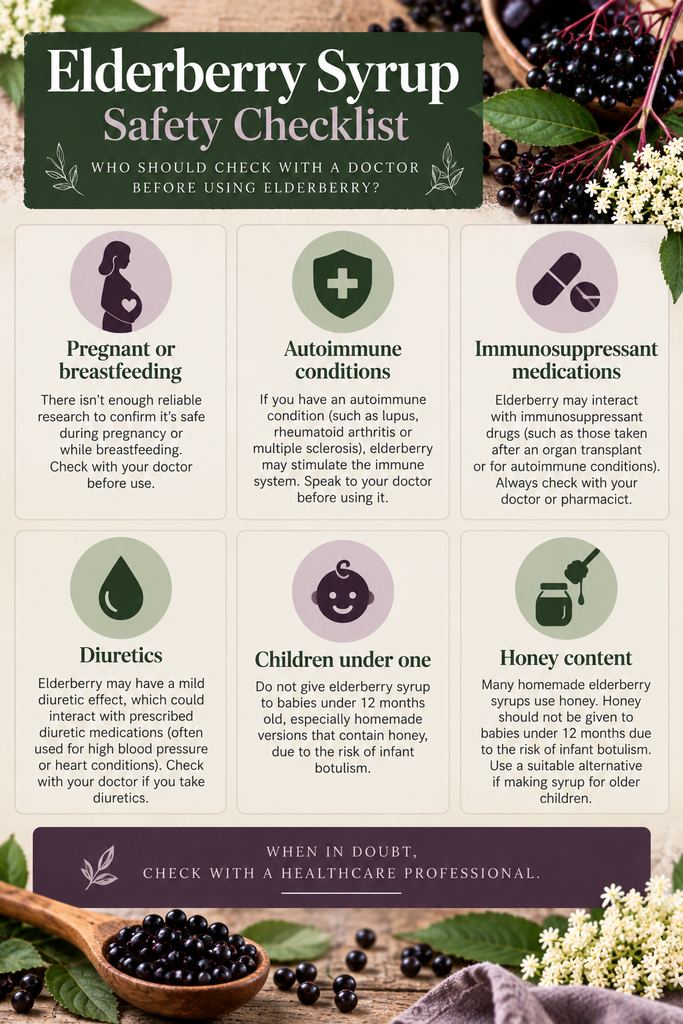
Beyond raw-berry toxicity, a few groups should talk to a doctor or pharmacist before using elderberry syrup at all:
- Pregnant or breastfeeding people. There isn’t enough research to say elderberry is safe in pregnancy, and some sources flag a theoretical risk around its immune-stimulating effects.
- Anyone with an autoimmune condition, such as lupus or multiple sclerosis, because elderberry’s immune-stimulating action could worsen disease activity.
- Anyone taking immunosuppressant medication, including drugs used after organ transplants or for autoimmune disease management, since elderberry may counteract how these medications are meant to work.
- Anyone taking diuretics, as elderberry may have a mild diuretic effect of its own and could increase the risk of dehydration in combination.
- Young children, particularly around honey-based syrups. Honey should never be given to a baby under one year old.
None of this means elderberry syrup is dangerous for most healthy adults in normal amounts. It means it deserves the same respect you’d give any other active plant remedy: know the contraindications, and check with a healthcare provider if you fall into any of the groups above. This isn’t medical advice, and it isn’t a substitute for a conversation with someone who knows your health history.
The underlying theme across most of these cautions is the same. Elderberry appears to stimulate certain immune pathways, and for most people that’s a mild, short-term effect with no real downside. For someone whose immune system is being deliberately suppressed by medication, or whose immune system is already overactive in an autoimmune condition, that same stimulating effect stops being neutral. It’s the reason a remedy that’s fine for most people isn’t automatically fine for everyone.
For a wider look at herbs used for cold and flu season, see our guide to antimicrobial and respiratory herb remedies, which takes the same evidence-first approach across a broader range of plants.
🍯 Using and Storing Elderberry Syrup at Home
If you already have a jar of elderberry syrup, whether homemade or shop-bought, a few sensible habits go a long way.
Keep it refrigerated. Homemade syrup without commercial preservatives typically keeps for two to three months in the fridge, though this varies by recipe, so always follow the specific instructions for the batch you made or bought. Give it a sniff and a look before using anything that’s been sitting for a while. If it smells off or has visible mould, discard it.
We’re deliberately not walking through the full syrup-making method here, because our beginner’s guide to herbal honey and syrups already covers the step-by-step process in detail, including ratios, straining, and storage times. If you’re planning to make your own, start there.
Once it’s made, airtight glass storage jars make it easier to keep syrup, dried elderberries, and other herbal preparations organised and properly sealed in the fridge or pantry, which matters more than people expect for shelf life.
A few other DIY preparations worth exploring if you enjoy this kind of home apothecary project include herbal infused oils, which follow a similarly safety-first approach.
❓ FAQ
Does elderberry syrup actually stop a cold? No study has shown that elderberry prevents colds or flu. The research that does exist suggests it may shorten the duration or ease the severity of symptoms once you’re already ill, though the evidence is limited and mixed.
Can I use elderflowers instead of berries? Elderflowers are a different part of the plant with a different, and generally less studied, profile. Most of the clinical research discussed here focused on berry extract, not flowers.
Is elderberry safe for children? Many commercial elderberry products are marketed for children, but always check age recommendations on the specific product, avoid honey-based versions for under-ones, and ask a pharmacist or GP if your child has any underlying health conditions.
How much elderberry syrup should I take? We’re not going to give a specific dosing recommendation here, because appropriate amounts vary by product concentration, age, and individual health. Follow the dosing on a reputable commercial product’s label, or ask a pharmacist if you’ve made your own.
🌿 Continue Your Journey
Curious about other herbs in the apothecary cluster? Here’s where to go next:
- Beginner’s guide to everyday medicinal herbs you can grow in pots
- Chamomile for sleep and calm: a beginner’s guide
- The mint family: calm, digestion and everyday wellness
- Preserving fresh herbs: drying, freezing and infusing
- Planning your perfect herb garden: the complete guide
Want more research-backed herb guides like this one delivered straight to your inbox? Sign up for the Green Herb Guru newsletter and never miss a new post.