Echinacea for Colds: Benefits, Evidence and How to Use It
Walk into any chemist or health shop in October and you will find echinacea lined up beside the vitamin C. The bottles promise a lot, yet the research behind them is a muddle, and that confuses plenty of home herb growers.
Some studies suggest a small effect. Others find nothing at all. Both can be true, and the reason is more interesting than a simple verdict.
This profile does not try to tell you echinacea works or that it does not. It explains why the trials disagree, what to look for on a label, and how to use the herb sensibly if you decide to try it. If you want the bigger picture first, our antimicrobial and respiratory herbs roundup covers several plants side by side.
As an Amazon Associate I earn from qualifying purchases and sometimes recommend products from other sellers at no extra cost to you. For more details see my disclosure policy and privacy policy.
Forged & Grown — The Shop
Handpicked products chosen to fit the way we cook, grow, and create. Nothing generic — every item earns its place.
Visit the Shop


🌸 Meet the Plant Behind the Products
Echinacea is a group of North American daisy-family perennials, often called coneflowers. Three species turn up in herbal products: Echinacea purpurea, Echinacea angustifolia and Echinacea pallida.
Traditionally, different parts of the plant were used. Modern products might contain the flowering tops, the leaves, the root, or a mix of these.
Here is the catch. Each species and each plant part has a different chemical make-up. A product made from purple coneflower juice is not the same as a root tincture from narrow-leaved coneflower, even though both say “echinacea” on the front.
🔬 Why the Evidence Is So Mixed
The best-known summary is a 2014 Cochrane review. It pooled 24 placebo-controlled trials with 4,631 participants, covering many different echinacea products.
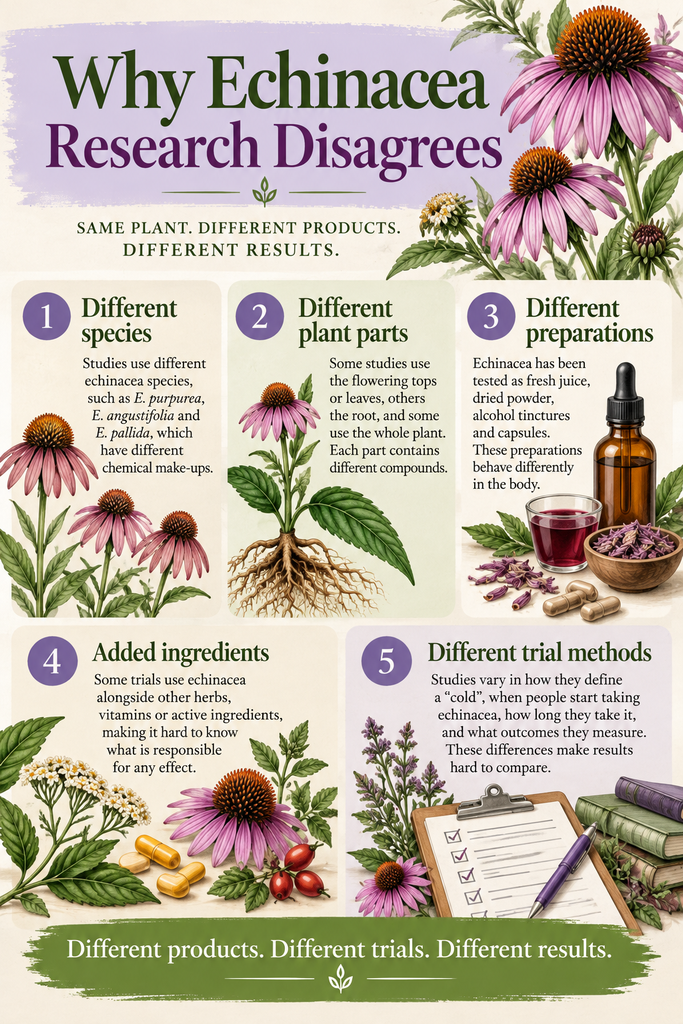
The reviewers described the evidence for any clinically useful effect as weak. They also noted that some products might do something, but that the trials were too different from each other to draw firm conclusions. That is a cautious statement, not a rejection.
Several things make echinacea trials hard to compare:
- Species: Some studies used E. purpurea, others E. angustifolia, and some used blends.
- Plant part: Aerial parts, roots and whole plants were all tested.
- Preparation: Pressed fresh juice, dried powder, alcohol tinctures and capsules behave differently.
- Added ingredients: Some products also contained other herbs or vitamins.
- Trial design: Studies differed in how they defined a “cold”, how quickly people started the product, and how long they took it.
Think of it like testing “bread” in a dozen trials. If one used sourdough, another rye, and a third a supermarket white loaf, a combined result would tell you very little about any single loaf.
A few later reviews and meta-analyses have reported small signals in some settings, and research on children is still emerging. Overall, the honest summary is that the question is not settled. I could not find a major review that clearly replaces the 2014 Cochrane work, but newer studies appear regularly, so it is worth checking for updates.
🛡️ Prevention Versus a Cold Already Under Way
People tend to lump two very different questions together.
The first is whether taking echinacea regularly for weeks changes how many colds you catch. The second is whether starting it once you feel a cold coming changes how long symptoms last.
In the Cochrane review, no statistically significant reduction in cold numbers was shown for prevention. However, nearly all prevention trials pointed in the direction of a small effect, which is why researchers keep studying it.
For colds already under way, only a minority of the treatment trials found a shorter duration. The overall picture was weak.
Neither finding means echinacea is useless, and neither means it is proven. It means the current evidence cannot answer either question with confidence. Remember too that most colds clear up by themselves within a week or two, which makes any small effect hard to spot.
🏷️ How to Choose a Product Without Getting Lost
If you decide to try echinacea, the label does most of the work. Look for these details:
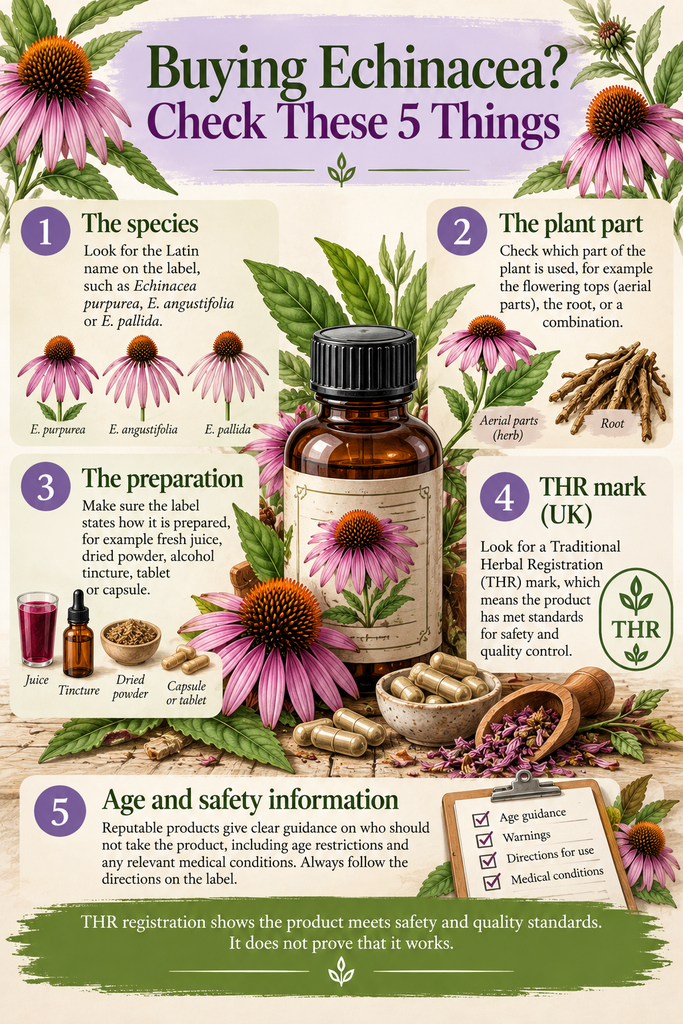
- The species: The Latin name should be clear, for example Echinacea purpurea.
- The plant part: Herb (aerial parts) or root, rather than just “echinacea extract”.
- The preparation: Juice, tincture, tablet or capsule, and how it was extracted.
- A clear age and use statement: Reputable products tell you who should not take them.
In the UK, look for a Traditional Herbal Registration (THR) mark. A THR means the product has met standards for safety and quality control, and that the claimed use rests on long-standing traditional use rather than clinical proof. It is a quality and safety signal, not a guarantee that it works.
Many echinacea supplements sold as food supplements are not covered by THR and can vary a lot in what they contain. Studies of herbal supplements around the world have found mismatches between label and contents, so a recognised registration and a reputable supplier matter.
I am not recommending any brand here. Whatever you choose, follow the directions on the product label rather than any dose you read online.
🍵 Using Echinacea at Home
Echinacea is usually taken as a ready-made product, or as a tea made from dried flowering tops or root. If you are new to herbal infusions, our guide to brewing herbal tea explains steeping times and equipment.
A few sensible habits apply:
- Use it for short periods only, rather than every day for months.
- Stop if you notice a rash, itching, swelling or breathing difficulty, and seek medical help straight away for anything serious.
- Keep a note of what you took and when, so you can tell whether anything helped.
- Do not treat it as a replacement for rest, fluids or medical advice.
If you enjoy a warm cup while you are under the weather, there are gentler options too. Our piece on herbal teas for the immune system looks at what is known about several plants, and the mint and lemon balm article covers soothing blends.
For another herb that has been studied for similar reasons, read our elderberry syrup and immune support profile.
⚠️ Safety: Who Should Take Care
Please read this section before you buy anything. Herbs are active plants, and “natural” does not mean “safe for everyone”.
Daisy-family allergy. Echinacea belongs to the Asteraceae family, along with daisies, ragweed, chrysanthemums and marigolds. If you react to those plants, you could react to echinacea. Allergic reactions, though uncommon, can occasionally be serious.
Autoimmune conditions and immunosuppressants. Echinacea is thought to stimulate parts of the immune system. People with autoimmune conditions, or anyone taking immunosuppressant medicines (for example after a transplant), should speak to their GP or pharmacist before using it.
Other medicines. Echinacea may affect how the liver processes some medications. If you take regular prescription medicines, check with a pharmacist first.
Pregnancy and breastfeeding. There is not enough reliable evidence to confirm that echinacea products are safe in pregnancy or while breastfeeding. Many products advise avoiding them, and UK food safety experts have been reviewing echinacea in the maternal diet. Ask your midwife or GP before using it.
Children. The MHRA has advised that echinacea products should not be given to children under 12, because of a small risk of allergic reaction. Always check the age limit on the label, and do not give children home-made preparations.
When to see a GP. Contact your GP or call NHS 111 if symptoms last longer than about ten days, you have a high fever, chest pain or difficulty breathing, or you are worried. A cold that will not shift can be something else.
If you are new to using herbs safely, our guide to herbal tea safety covers pregnancy, medicines and everyday limits in more detail, and our beginner’s apothecary guide shows how to build a sensible home herb routine.
🌿 A Quick Word on Echinacea in the Garden
Echinacea is also a lovely perennial for UK borders, with daisy-like flowers that bees and butterflies enjoy late in summer. It is a separate subject from the herbal products above, and this post is not a growing guide.
If you would like to start with easier herbs in pots, our beginner’s guide to medicinal herbs you can grow in pots is a gentle place to begin.
❓ Frequently Asked Questions
Does echinacea work for colds? The evidence is mixed. Trials use very different products, so results are hard to combine. Some suggest a small effect and others find none.
Which type of echinacea is best? There is no agreed answer. Check the species, plant part and preparation on the label, and choose a product from a reputable maker.
Can I take echinacea all year? Herbal advice is generally to use it for short periods only. Follow the label, and speak to a pharmacist if you want to use it for longer.
Is echinacea safe for children? In the UK, the MHRA advises against giving echinacea products to children under 12. Always check the label and ask a pharmacist or GP.
Can I use echinacea if I am pregnant? There is not enough evidence to say it is safe. Talk to your midwife or GP before using any herbal product.
What is a THR mark? It stands for Traditional Herbal Registration, a UK scheme for herbal medicines that checks safety and quality. It does not prove that a product works.
This post is for general information and is not medical advice. Herbs can interact with medicines and may not suit everyone, including people who are pregnant, breastfeeding, taking medication or caring for children. Speak to your GP or pharmacist before trying a new herbal product.
🌱 Continue Your Journey
- Chamomile for Sleep and Calm: A Beginner’s Guide
- How to Grow and Use Lemon Balm: From Garden to Teacup
- Warming Winter Herb Teas: Your Guide to Seasonal Comfort
- Beginner’s Guide to Herbal Honey and Syrups
- Making Herbal Infused Oils at Home: A Safety-First Guide
Want more calm, practical herb guidance each week? Join the Green Herb Guru newsletter and grow your herbal know-how at your own pace.


