
Winterising Your Herb Garden: Protecting Perennials Through the Cold
Every November the same thing happens in herb gardens across the UK. The mint vanishes, the chives flop, and a well-meaning gardener rushes out with a blanket of fleece, a heap of compost and a lot of worry. Meanwhile the thyme, quietly evergreen, is being smothered in the very thing that will rot it.
Herbs do not all face winter in the same way. Some switch off completely, some tick over slowly, and a few simply cannot cope with frost. Once you know which is which, protecting them gets much easier and a lot less fussy.
This guide sorts your herbs into three winter types and shows what each one actually needs. It covers dormancy, protection and the real enemies of a winter herb patch, which are not always the ones you expect. Metric measurements come first, with Fahrenheit alongside for temperatures.
As an Amazon Associate I earn from qualifying purchases and sometimes recommend products from other sellers at no extra cost to you. For more details see my disclosure policy and privacy policy.
Forged & Grown — The Shop
Handpicked products chosen to fit the way we cook, grow, and create. Nothing generic — every item earns its place.
Visit the Shop


🌿 Three Winter Personalities
Think of your herbs as belonging to one of three groups. Each reacts to the cold differently, so each needs a different approach.
Fully dormant. These die back to the ground and rest until spring. Mint, chives, lemon balm, French tarragon and oregano all do this.
Semi-evergreen or woody. These keep their leaves, though growth slows to a crawl. Thyme, sage, rosemary, winter savory and hyssop belong here.
Tender. These cannot take frost at all. Lemongrass, Thai basil and, in most places, lemon verbena fall into this group.
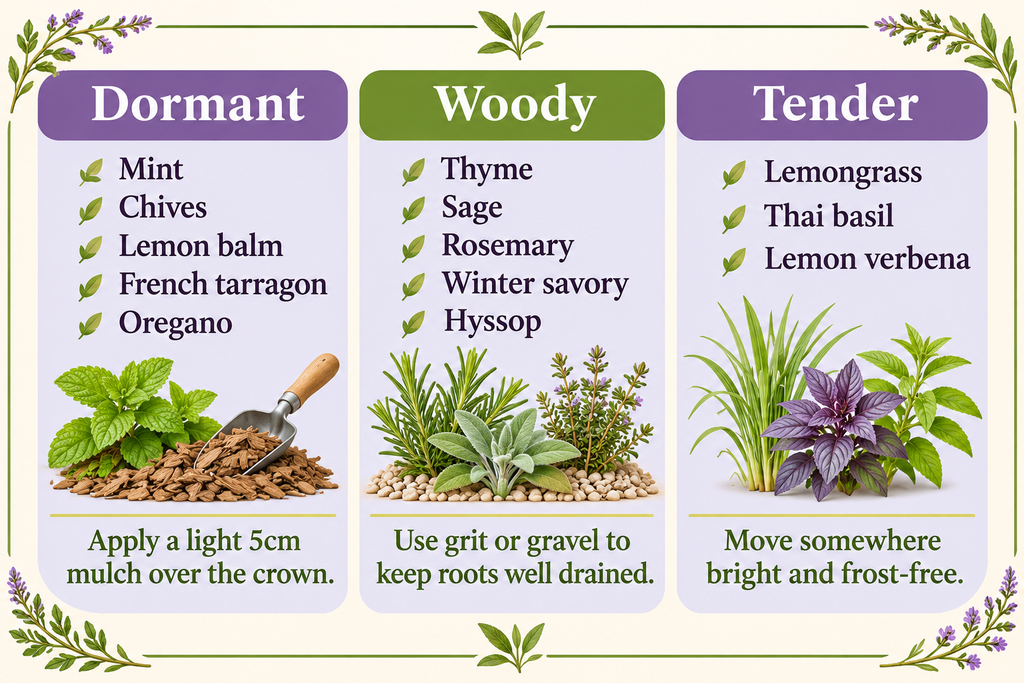
Knowing the group tells you the job. Dormant herbs mostly need leaving alone. Woody herbs need good drainage and shelter. Tender herbs need to be out of the cold altogether.
😴 Fully Dormant Herbs: Mostly Leave Them Be
A dormant herb looks dead, but the roots are alive and waiting. The most useful thing you can do is resist the urge to fuss.
Mint is the classic example. The RHS describes it as a herbaceous perennial that dies back over winter and returns each spring. If you want to know how it behaves in different spots, our guide to the mint family covers it in detail.
Chives, lemon balm and oregano behave in much the same way. Their stems collapse after the first hard frosts, and the crowns stay safe underground.
French tarragon also dies back. It dislikes sitting in cold, wet soil, so good drainage matters more than extra cover. Our tarragon guide explains why.
For all of these, a light mulch over the crown after the ground has chilled is plenty. Garden compost, leaf mould or well-rotted bark work well, applied about 5cm (2 inches) deep.
🌲 Woody and Semi-Evergreen Herbs: Keep Them Dry
These are the herbs most often over-protected. Thyme, sage and rosemary are evergreen shrubs, built for tough conditions.
The RHS says most widely sold thyme varieties can withstand frost and UK winters. Rosemary is hardy through most of the UK, though it may want some shelter in colder places. It can survive temperatures down to around -8°C (18°F), but harsh frost and cold wind can damage the shoots.
The common thread is wet. As Gardeners’ World puts it, wet conditions kill more herbs in winter than the cold does. Roots sitting in cold, soggy soil simply rot.
So the aim is to keep these herbs dry at the roots, not warm. Our guides to growing sage and growing thyme both show how to set them up in free-draining soil.
Gravel, not blankets
For Mediterranean herbs, a mulch of grit or gravel around the base is better than anything organic. The RHS recommends it for thyme, because it lifts the low foliage off damp soil.
Keep thick, soggy mulches such as compost or bark away from the stems and crowns of thyme, sage and rosemary. Trapped moisture against woody stems is an invitation to rot.
💨 Wind and Wet: The Real Troublemakers
It is tempting to blame frost for every winter casualty. In practice, wind and waterlogging do a great deal of the damage.
Cold, drying wind can scorch evergreen foliage, leaving brown, crisp tips even when the temperature never drops very low. Rosemary and sage are particularly prone to this in exposed spots.
If your garden is open, a few simple measures help:
- Position pots against a wall, house or garage, where they are sheltered from the worst of the wind and rain. Gardeners’ World estimates that a sheltered spot can cut the rain reaching a pot by about 25 per cent.
- Use a windbreak such as a hurdle, a hessian screen or a row of sturdier shrubs.
- Group pots together so they shelter one another.
Wind protection should let air move gently through. A solid wrap that traps damp air can cause as many problems as it solves.
🛡️ Fleece, Hessian and When to Use Them
Most hardy herbs do not need covering. The exception is a cold snap that is unusually hard, or a plant that is young, newly planted or growing in a pot.
For those moments, horticultural fleece is breathable and light, so it keeps off frost without trapping moisture. Hessian does a similar job and looks rather lovely in a cottage-style garden.
Drape the fleece loosely over rosemary or a young sage plant on the coldest nights, and take it off in milder weather so the plant can breathe. Leaving it on for weeks in damp conditions invites mould.
If you can, avoid plastic coverings. They hold in moisture, which is exactly what woody herbs dislike.
🪴 Looking After Herbs in Pots
Containers are the weak point of any winter herb garden. A pot is exposed on every side, and its compost gets colder and wetter than the open ground.
Here is what helps most:
- Raise them off the ground. Stand pots on bricks, wood blocks or pot feet so the drainage holes stay clear. This also helps stop pots cracking as trapped water freezes and expands.
- Check the weight. A light pot is dry, and a heavy pot is wet. Water lightly in the morning only if the compost has dried, never in the evening when it may freeze overnight.
- Group and shelter. Cluster pots in the lee of a wall, or tuck them under an overhang so heavy rain cannot soak them. The RHS also suggests a sheet of glass or plywood over the top in very wet regions.
- Insulate the sides, not the stems. Wrapping the pot itself in hessian keeps the roots from freezing, while the plant above stays open to the air.
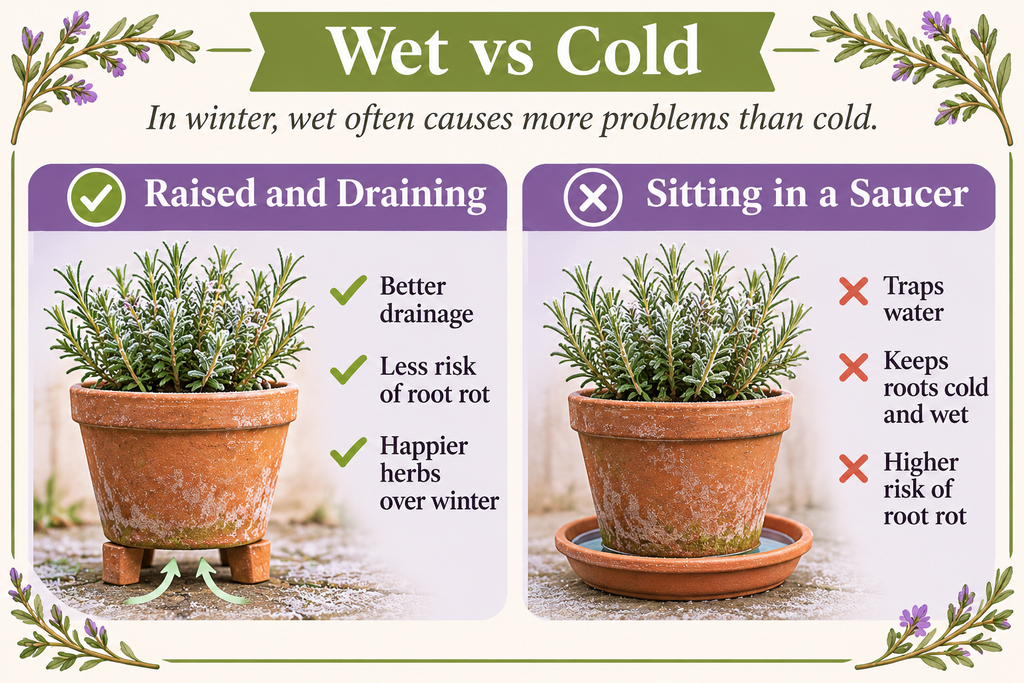
Terracotta looks beautiful but can crack in hard frost if it stays saturated. Glazed or frost-proof pots cope better, and raising them makes a real difference.
🌱 Tender Herbs: Out of the Cold
Some herbs will not forgive a frost, and no amount of fleece will change that. Basil is the best-known example, and Gardeners’ World notes that temperatures much below 5°C (41°F) will kill it.
Thai basil is just as tender, so it belongs on a bright, frost-free windowsill. Our Thai basil guide has its growing needs in full.
Lemongrass is also frost-tender. It needs a warm, bright indoor spot until spring, and our lemongrass guide explains how to keep it going. Lemon verbena may come through a mild winter in a very sheltered place, but it is safer to protect it.
If you have already moved plants indoors earlier in the autumn, our October herb jobs post walks through that step. This guide picks up from there.
🪟 A Short Note on Winter Windowsills
If you are keeping a few herbs on the windowsill, winter changes the rules. Light is weaker, the days are short, and the heating is on.
A few points to remember:
- Give them the brightest spot you have, and turn pots every few days.
- Water less. Growth slows, so compost stays damp for longer.
- Keep them away from radiators and cold glass overnight, as both cause stress.
- On very dull days, a grow light for herbs can make up the shortfall.
For the full setup, see our guide to kitchen herb micro-gardens. It covers the basics without repeating them here.
✂️ To Cut Back or Leave Alone?
This one trips up many beginners. The answer depends on your herb’s winter personality.
Dormant herbs: Once the stems have died back, you can tidy them away. The RHS notes that mint can be cut back from late autumn to spring, just before new shoots appear. Some gardeners leave the stems standing over winter for the insects, and that is perfectly fine too.
Woody herbs: Go gently. A light trim to tidy the shape is fine, but deep cuts into old wood may not regrow. The RHS advises trimming rosemary and thyme lightly after flowering and saving any bigger tidy-up for mid to late spring.
In short, autumn is rarely the right time for a hard prune on a woody herb. Fresh growth stimulated by pruning is easily damaged by frost.
⚠️ A Quick Safety Note
Everything above is about caring for plants, but many people also use their herbs in the kitchen or in teas. A few sensible precautions apply to every herb you grow and use.
- Pregnancy and breastfeeding: Some herbs are fine in cooking quantities but not in strong teas or concentrated preparations. If you are pregnant or breastfeeding, check with your midwife, GP or pharmacist before using herbs in anything beyond normal food amounts.
- Medications: Herbs can interact with prescription medicines. If you take regular medication, ask your pharmacist or doctor before using herbs medicinally.
- Children: Keep herb preparations out of reach of little ones, and do not give children herbal teas or concentrated products without medical advice.
- Identification: Only use a herb you are completely sure you have identified correctly.
This post is general gardening information and not medical advice. For more detail on teas and everyday limits, read our guide to herbal teas and safety.
❓ Frequently Asked Questions
Do I need to cover my herbs in winter? Most hardy herbs do not. Thyme, sage, mint and chives cope well with a typical UK winter. Young plants, potted herbs and tender types are the ones that benefit from protection.
Why did my thyme die even though it was cold-hardy? Wet is the usual culprit. Poor drainage and soggy compost rot the roots long before the frost does.
Should I mulch my herbs? Yes, but choose carefully. A light organic mulch suits dormant herbs, while grit or gravel is better for thyme, sage and rosemary.
Is it normal for my mint to disappear? Completely normal. Mint is herbaceous, so it dies back to the ground and returns in spring.
Can I leave pots outside all winter? Many hardy herbs can, provided pots drain well, sit off the ground and have some shelter from wind and heavy rain.
🌸 Your Winter Herb Checklist
Winterising is really a handful of small habits, and not a big project.
- Sort your herbs into dormant, woody and tender.
- Leave dormant herbs alone, with a light mulch if you like.
- Keep woody herbs dry, using grit around the base and good drainage.
- Shelter pots, raise them off the ground and group them together.
- Bring tender herbs somewhere frost-free.
- Go easy on the secateurs until spring.
Do that, and your herb garden will wake up in spring looking healthy rather than smothered.


