
French Herb Classics: Herbes de Provence, Tarragon and the Art of the Bouquet Garni
Walk into a French kitchen and you won’t find a herb rack labelled by Latin name. You’ll find a jar of something dried and dusty green kept by the stove, a bundle of stems tied with kitchen string simmering away in the stockpot, and a small pile of freshly snipped leaves waiting to go into the eggs at the very last second.
Three different herb systems, three different jobs, and none of them interchangeable. Once you understand what each one is actually for, cooking with French herbs stops feeling like following a shopping list and starts feeling like following a logic.
As an Amazon Associate I earn from qualifying purchases and sometimes recommend products from other sellers at no extra cost to you. For more details see my disclosure policy and privacy policy.
What Makes French Herb Cooking Different
French cooking treats herbs as tools tied to a specific technique and a specific moment in the cooking process, not as a garnish added at the end for colour. A blend meant to survive an hour in the oven is built differently to a mix meant to be stirred into eggs seconds before they hit the plate.
Forged & Grown — The Shop
Handpicked products chosen to fit the way we cook, grow, and create. Nothing generic — every item earns its place.
Visit the Shop


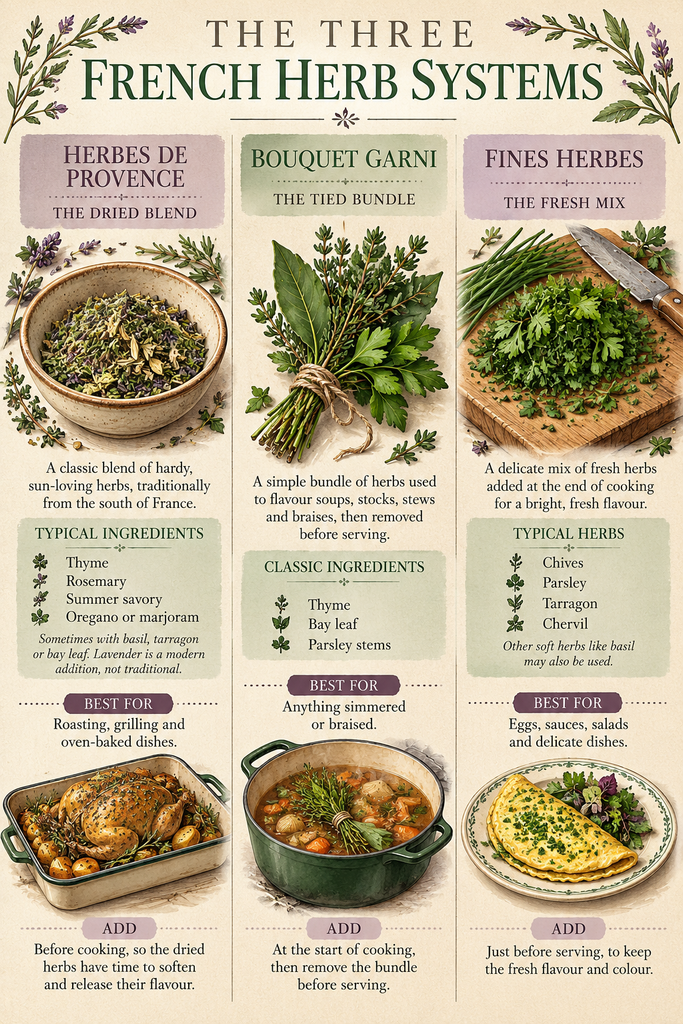
That distinction is the thread running through this guide. We’ll cover the three main systems: herbes de Provence for slow, dry heat, the bouquet garni for anything simmered or braised, and fines herbes for the delicate stuff. Along the way we’ll answer the lavender question everyone eventually asks, and the tarragon question that trips up more gardeners than it should.
This is the next stop in our International Cuisines series, following on from Italian Herbs: Basil, Oregano, Rosemary and the Foundations of Italian Cooking. Where Italian cooking leans on a handful of herbs used generously and often fresh, French cooking is more particular about format: dried and robust, or fresh and fleeting, rarely both at once.
Herbes de Provence: The Blend Behind the Jar
Herbes de Provence is the one most people already own, even if they’ve never thought about what’s actually in it. The traditional mix draws on hardy, dry-climate herbs that grow wild across the south of France:
- Thyme
- Rosemary
- Summer savory (sarriette)
- Oregano or marjoram
Some versions add a little basil, tarragon or bay leaf, and there’s no single official recipe. What there isn’t, traditionally, is lavender. Dried lavender flowers became a common addition to commercial blends sold outside France, largely because the colour and scent read as unmistakably “Provence” to an export market, even though older French cooking didn’t lean on it this way. If your jar has lavender in it, that’s not wrong exactly, it’s just a modern, more decorative version rather than the working kitchen blend.
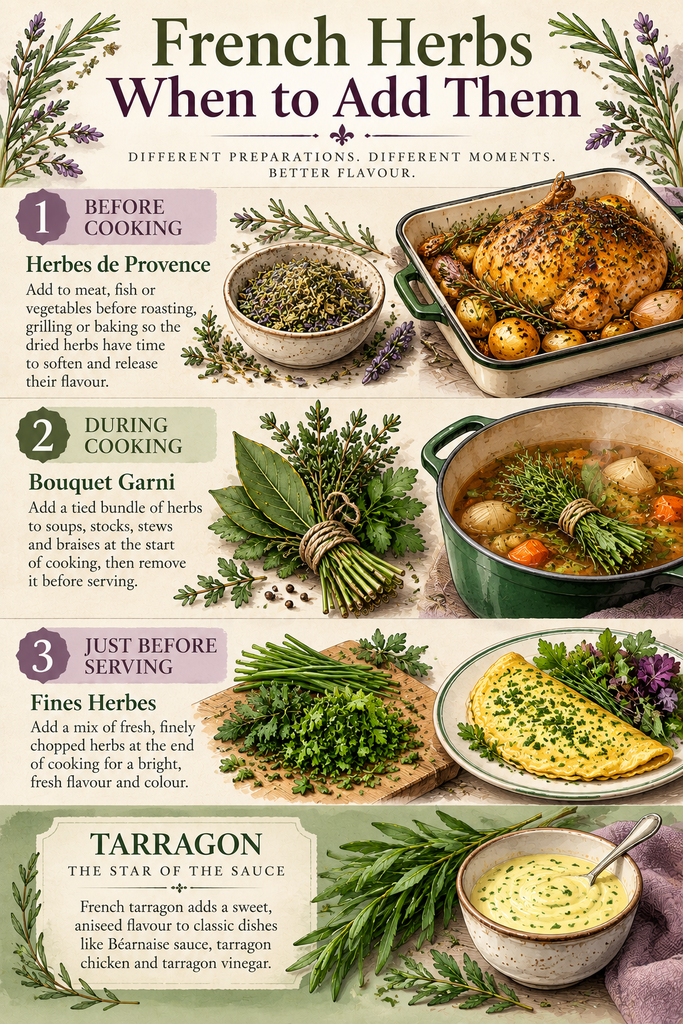
Because the herbs are all dried and fairly robust, herbes de Provence is built for dry heat and time: roast chicken, roasted vegetables, a pork loin, a pan of oven-baked tomatoes. Rub it into the skin before roasting and let the oven do the work, rather than sprinkling it on at the end where the dried texture has no chance to soften.
If you’re buying rather than blending, a quick freshness check saves disappointment. Good herbes de Provence should smell distinctly resinous and herbal the moment you open the jar, not dusty or faint. If you have to hold it right up to your nose to notice anything, it’s likely been sitting on a shelf too long and won’t do much for whatever you’re cooking. Colour is a decent shortcut too: a faded, greyish-green mix has usually lost most of its oils along with its colour.
If you want to blend your own rather than buy a jar, we’ve already covered ratios and method in How to Make Popular Herb and Spice Blends, including a version of this exact mix. Once you’ve made a batch, an airtight container matters more than people expect. Dried herbs lose their punch fast in anything that isn’t sealed properly, so a set of proper airtight glass herb and spice jars will keep a homemade batch tasting like something worth making again. For a finished example of the blend at work, our Grilled Herbes de Provence Crusted Lamb Chops recipe shows exactly how it behaves under direct heat.
Tarragon: France’s Most Particular Herb
Tarragon deserves its own section because it causes more confusion at the garden centre than almost any other culinary herb. Seed packets labelled simply “tarragon” are almost always Russian tarragon, a hardier, easier-to-grow plant with a noticeably flatter, more grassy flavour. French tarragon, the variety French cooking actually means, is largely sterile and doesn’t come true from seed, so it has to be grown from cuttings or bought as an established plant. It’s fussier to establish but carries the sweet, aniseed note that makes the effort worthwhile.
That flavour is why tarragon shows up in some of the most recognisable dishes in French cooking. Béarnaise sauce, the warm emulsion of butter, egg yolk and reduced vinegar served alongside steak, gets its signature edge from tarragon steeped into that reduction. Poulet à l’estragon, tarragon chicken braised gently with cream and a generous handful of the fresh herb, is a home-cooking classic built almost entirely around what tarragon can do to a simple sauce. It’s also the base for tarragon vinegar, made by steeping fresh sprigs in white wine vinegar for a few weeks, useful well beyond French recipes.
Tarragon Dijon mustard, made by steeping the fresh leaves in mustard along with a splash of white wine, is another classic worth knowing, good stirred into a vinaigrette or spread thinly under chicken skin before roasting. Because fresh tarragon fades fast in the fridge, it’s worth freezing what you don’t use straightaway. Chop it finely, pack it into ice cube trays with a little water or melted butter, and you’ll have pre-portioned tarragon ready for a sauce months after the growing season ends.
If you’re growing your own, our full tarragon growing and propagation guide covers how to source true French tarragon, keep it going year to year and take your own cuttings rather than restarting from seed each spring.
The Bouquet Garni: Flavour You Can Fish Back Out
Where herbes de Provence goes into a dish and stays there, a bouquet garni is designed to be removed. It’s a small bundle of herbs added at the start of a long simmer purely to infuse flavour, then lifted out before serving, the way a tea bag steeps and gets binned.
The classic version is simple: fresh thyme, a bay leaf and a few parsley stems (the stems, not the leaves, since they hold up better to long cooking). Tie the bundle with kitchen string, or wrap it first in a piece of leek’s outer leaf for extra body and to keep everything together. For a dried pantry version when fresh herbs aren’t to hand, the same ratio works tied inside a small square of muslin or cheesecloth instead.
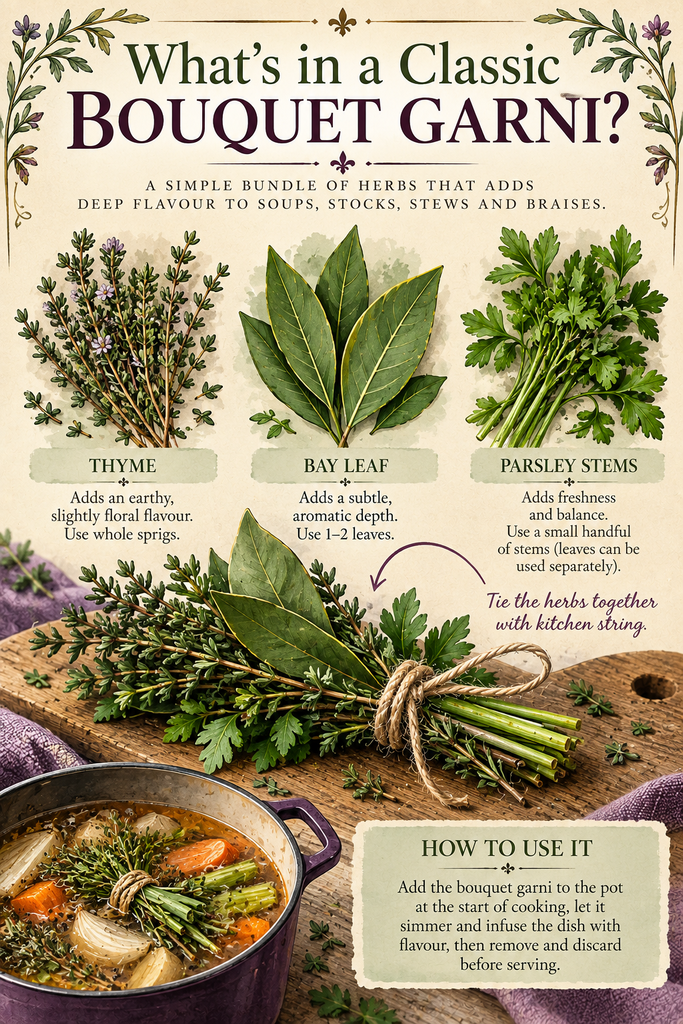
Bouquet garni belongs in anything that simmers for a while and would otherwise be a nuisance to strain: a pot-au-feu, a poaching liquid for chicken or fish, a red wine braise, or a simple stock. Drop it in at the start, forget about it, then lift it out with a slotted spoon once the dish is done. If tying a bundle feels fiddly, a reusable metal tea infuser or a large mesh tea ball does the same job with less string, and it’s easier to fish back out of a busy pot.
The classic thyme, bay and parsley trio isn’t fixed in stone. A daube, the slow-braised beef stew from Provence, often adds a strip of orange peel to the bundle. Some stock recipes include a clove or two, or a stick of celery alongside the herbs, for a slightly rounder base note. Treat the classic formula as the starting point and adjust it to whatever the pot is actually simmering. For the two herbs doing most of the work in the standard bundle, see our full guides to bay leaf and thyme, both of which cover growing, harvesting and drying in more depth than we’ll get into here.
Fines Herbes: The Delicate Opposite of Herbes de Provence
If herbes de Provence is the robust, dried, long-cooking end of French herb use, fines herbes is the exact opposite. The classic mix is parsley, chives, tarragon and chervil, always fresh, always finely chopped, and always added right at the end of cooking or not cooked at all.
Escoffier, the chef whose codified French technique still shapes professional kitchens today, was strict about this: a dish described “aux fines herbes” needed all four herbs together, not parsley standing in alone. The logic is that each herb contributes something the others don’t: chives for mild onion, tarragon for aniseed sweetness, chervil for a soft, almost fern-like freshness, parsley to tie it together.
Fines herbes belongs on omelettes and scrambled eggs, folded into a simple green salad, stirred into a beurre blanc just before serving, or scattered over poached fish. None of it survives real cooking heat well, which is exactly the point: it’s meant to taste like it was picked minutes ago. Chervil is the herb most people don’t already grow, so our chervil growing guide is worth a look if you want the full set on your windowsill.
Reach For This When
- Roasting a chicken, a pork loin or a tray of root vegetables: herbes de Provence, rubbed on before it goes in the oven.
- Making a stock, a braise or anything that simmers for an hour or more: a bouquet garni, dropped in at the start and fished out at the end.
- Finishing eggs, fish or a simple salad seconds before it hits the table: fines herbes, fresh and finely chopped.
- Building a sauce or a dish where one herb needs to be the star, like béarnaise or poulet à l’estragon: tarragon on its own.
FAQ: French Herb Cooking Questions
Can I use herbes de Provence instead of a bouquet garni? Not really. Herbes de Provence is a dried rub or seasoning meant to stay in the dish, while a bouquet garni is a bundle designed to be removed. Swapping one for the other changes both the texture and the strength of flavour you end up with.
Is lavender essential for authentic herbes de Provence? No. It’s a common addition in commercial blends made for export, but it isn’t part of the traditional working mix, so leaving it out is just as authentic, arguably more so.
Can I make fines herbes with dried herbs? It works in a pinch, but dried chervil and tarragon lose most of the delicate character that makes fines herbes worth using in the first place. Fresh is genuinely worth the extra step here.
Why is my tarragon plant so much milder than restaurant tarragon? It’s most likely Russian tarragon grown from seed rather than French tarragon grown from a cutting. Check the label on your original plant, or take a cutting from a known French tarragon plant to be sure next time.
French herb cooking rewards matching the herb to the job rather than reaching for whatever’s nearest the stove. Once the three systems click into place, dried for long slow cooking, bundled for infusing, fresh for finishing, the rest of French cooking’s herb logic tends to make a lot more sense too.
Continue Your Journey
- The Ultimate Guide to Parsley
- Chives: A Comprehensive Guide
- Essential Herbs and Spices: Elevate Every Kitchen Dish
- Planning Your Perfect Herb Garden: The Complete Guide
- Oregano: The Complete Guide to Growing, Cooking, and Using This Mediterranean Staple
Want the next instalment in this series delivered straight to your inbox? Sign up to our newsletter for a new world cuisine’s herb cabinet every few weeks.


