
Herbs Around the World: How Different Cuisines Use Fresh and Dried Herbs
Walk into a kitchen in Bangkok, Beirut, Bologna and Mexico City on the same evening, and you’ll find someone reaching for herbs in four different ways. One cook tears basil off the stem seconds before the bowl reaches the table.
Another rubs dried thyme into a pot that won’t be touched again for an hour. A third stirs a dried herb and sesame blend into olive oil, and a fourth sprinkles a herb-based condiment over a dish already plated.
None of them is doing it “wrong.” They’re cooking within a tradition that decided, generations ago, how a particular herb behaves best.
Most articles about fresh versus dried herbs treat it as one universal rule: use three times as much fresh as dried, add dried herbs early, fresh herbs late, done. That rule isn’t wrong, but it flattens something more interesting.
Forged & Grown — The Shop
Handpicked products chosen to fit the way we cook, grow, and create. Nothing generic — every item earns its place.
Visit the Shop


Whether a cuisine reaches for fresh or dried by default has as much to do with climate, trade history and how a dish is built as it does with flavour chemistry. This guide starts with the science, then walks cuisine by cuisine through how that plays out in real kitchens, so next time a recipe calls for oregano, you’ll know whether to reach for the pot on the windowsill or the jar in the cupboard.
This is also the hub for a growing series: as dedicated posts for each cuisine cluster go live, they’ll be linked in from the sections below, so bookmark this page for the fuller picture as it fills in.
As an Amazon Associate I earn from qualifying purchases and sometimes recommend products from other sellers at no extra cost to you. For more details see my disclosure policy and privacy policy.
🌿 Why Fresh and Dried Herbs Taste So Different
Every herb’s flavour comes from volatile oils, the aromatic compounds that give basil its peppery sweetness or rosemary its piney bite. “Volatile” is the key word: these compounds evaporate, and drying is a controlled evaporation process.
As water leaves the leaf, the remaining oils concentrate by volume, which is why dried herb can taste more intense, spoonful for spoonful, than fresh. But some aromatic compounds are lost entirely during drying, not just concentrated, and how much survives depends on the herb itself.
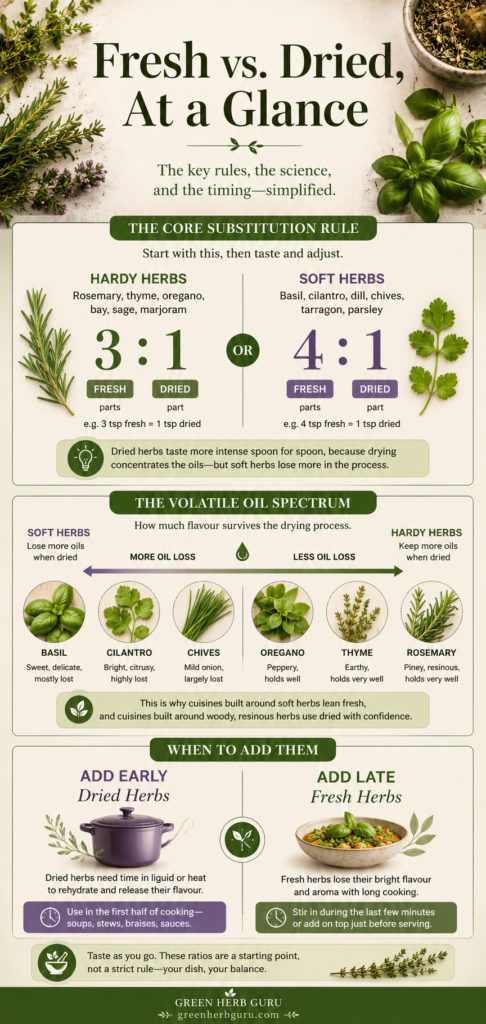
Hardy, woody herbs (rosemary, thyme, oregano, bay) hold onto a good share of their oils when dried, sometimes 70% or more, which is why dried versions still taste recognisably like themselves. Soft, leafy herbs (basil, cilantro, chives, dill, tarragon) lose a much larger share, which is why dried basil tastes more like “green” than “basil.” That’s the underlying reason cuisines built around soft herbs lean almost entirely on fresh, while cuisines built around woody, resinous herbs are far more comfortable reaching for the dried jar.
The standard conversion, three parts fresh to one part dried, is a reasonable starting point for hardy herbs, but soft herbs often need closer to four parts fresh to one part dried for the same flavour. Dried herbs also need time in liquid or heat to rehydrate, so they’re best added early, while fresh herbs added too early simply cook away. Stir fresh herbs in during the last few minutes, or onto the finished plate, and add dried herbs when you’re building a base of aromatics.
🍳 The General Rule of Thumb for Cooking
One working principle helps before diving into individual cuisines: dried herbs season the dish as it cooks, fresh herbs season it as it’s eaten. Long-simmering soups, stews and braises are where dried herbs earn their keep, since there’s time for them to unfurl.
Quick sautés, raw preparations and anything served minutes after finishing are fresh herb territory, where you want bright, uncooked aromatics. It’s a useful lens below: cuisines that build dishes slowly, in liquid, tend to be comfortable with dried herbs; ones built around quick or no cooking lean almost exclusively fresh.
Mediterranean Kitchens: Basil, Oregano and Rosemary as Everyday Staples
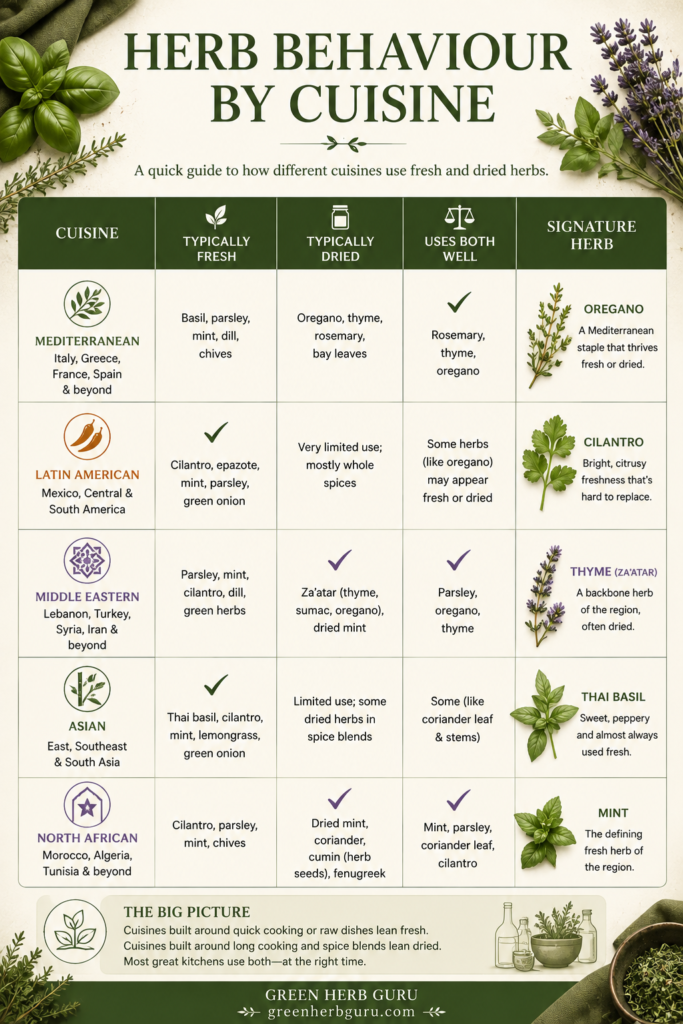
Mediterranean cooking uses both fresh and dried herbs comfortably, often in the same meal, because its food culture spans everything from quick tomato sauces to slow-roasted meats. Basil is the clearest fresh-only case: it’s the backbone of pesto and is torn over a finished Caprese or tomato sauce because its sweet, peppery character disappears with heat or drying.
Oregano moves the other way. Wild Mediterranean oregano is often used dried, particularly over grilled meats, fish and Greek salad, because its flavour holds up through drying and mellows into something rounder.
Rosemary sits in between. Its woody, piney oils survive both fresh and dried use, which is why it turns up in herbes de Provence style blends for roasted lamb as easily as tucked fresh under a roast chicken’s skin. A good Italian seasoning blend, built mostly from dried oregano, basil and rosemary, is a genuinely useful weeknight shortcut, precisely because those herbs dry so well together.
🌶️ Latin American Kitchens: Cilantro, Epazote and Fresh-at-the-End Flavour
Latin American cooking, and Mexican cooking especially, leans fresh far more often than dried, and cilantro is the reason most people notice it. Its citrusy brightness comes almost entirely from volatile compounds that don’t survive drying, which is why dried cilantro barely exists as a pantry staple. It goes into salsa verde, guacamole and garnishes right at the point of serving, never earlier.
Epazote is the more unusual case: a strong, almost camphor-like herb used in central and southern Mexican cooking, particularly in bean dishes, where it’s credited with cutting down the gassiness beans are notorious for. It’s used fresh and sparingly, since its flavour turns overpowering fast.
Mexican oregano, worth flagging separately, isn’t the same plant as Mediterranean oregano at all. It’s more citrusy and slightly liquorice-like, and it’s one of the few herbs in this cuisine genuinely at home dried, worked into moles and long-simmered stews the way Mediterranean cooks use dried thyme.
A chimichurri, built on fresh parsley and often fresh oregano, shows how differently the same herb name can behave depending which side of the Atlantic it’s grown on.
🍃 Southeast Asian Kitchens: A Fresh-Herb-First Philosophy
If Latin American cooking leans fresh, Southeast Asian cooking, particularly Thai and Vietnamese food, goes almost all in. Dried herbs are genuinely rare here, largely because the climate keeps fresh herbs available year-round, so there was never much reason to develop a drying tradition the way cooler, seasonal climates did.
Thai basil, with its sweet, faintly anise-like flavour, is added at the very end of a curry or scattered over noodle soup rather than cooked through. Vietnamese cooking takes this further: herbs like mint, Vietnamese coriander and perilla are served raw, often at the table, added leaf by leaf to a bowl of pho or wrapped fresh into rice paper rolls, exactly because their volatile oils are the entire point.
Cilantro plays a different supporting role here than in Latin American cooking, softening a broth’s richness or cutting through grilled meat’s char, but the underlying principle is identical: these are aromatics meant to be tasted raw, not simmered into a base. There isn’t a strong dried-herb tradition to link out to yet in this cluster; when the dedicated Southeast Asian herbs post publishes, it’ll sit here.
🫓 Middle Eastern Kitchens: Za’atar, Sumac and the Dried-Herb Pantry
Middle Eastern cooking sits closer to the Mediterranean end of the spectrum, with a genuine, longstanding comfort with dried herbs and herb blends.
Za’atar is the clearest example: both the name of a family of wild herbs related to oregano and thyme, and the name of the finished blend, dried herbs mixed with toasted sesame seeds, sumac and salt, stirred into olive oil for dipping bread or sprinkled dry over roasted vegetables and meat. It’s built to be shelf-stable and used often, a very different design goal to a fresh herb.
Parsley and mint, by contrast, are used constantly fresh, particularly in tabbouleh, where parsley isn’t a garnish but the main ingredient, and in yoghurt sauces and salads. Mint genuinely works both ways here: fresh in salads, marinades and drinks, dried in flatbreads, over eggs and stirred into cooked yoghurt dishes.
Sumac, technically a spice rather than a herb, works the same room as dried herbs do: a finishing touch of tartness sprinkled over hummus or fattoush rather than cooked in.
French Kitchens: Bouquet Garni and the Art of the Herb Bundle
French cooking has arguably formalised the fresh-versus-dried question more than any other tradition here, mostly through two tools that get confused with each other constantly.
A bouquet garni, classically parsley, thyme and bay leaf tied into a bundle (sometimes wrapped in cheesecloth or leek), is dropped into a long-simmering stock, stew or braise and pulled out before serving. It can be made with fresh or dried herbs, but its job is to flavour a liquid gently over time, then disappear.
Herbes de Provence is different: a dried blend, typically thyme, rosemary, bay, oregano and marjoram (sometimes a touch of lavender), stirred directly into a dish and left there. Where a bouquet garni is a technique, herbes de Provence is closer to a spice-rack shortcut. The two get lumped together because they share ingredients and a home region, but the difference (infuse-and-remove versus stir-and-stay) is genuinely useful next time a French recipe calls for one or the other.
🌱 Grow Your Own or Buy Dried? A Cluster-by-Cluster Guide
Not every herb here is worth growing at home, and that’s fine. A realistic starting point by cluster:
Mediterranean: basil, oregano and rosemary are some of the easiest herbs to grow in a sunny pot, and a bit of planning around light and space pays off since you’ll use all three constantly.
Latin American: cilantro is worth growing if you cook Mexican food often, since it bolts quickly in heat and is genuinely better fresh from your own pot than a wilted supermarket bunch. Epazote and Mexican oregano are harder to find as plants and are reasonable to buy dried instead.
Southeast Asian: Thai basil and mint grow easily and reward the effort, since fresh is the only way these cuisines use them. Vietnamese coriander and perilla are trickier to source but worth seeking out if you cook Vietnamese food regularly.
Middle Eastern: mint and parsley are easy, productive pot herbs. Za’atar (the wild herb) is harder to grow outside its native climate, so the finished blend is the practical choice.
French: thyme, rosemary and bay are hardy, low-maintenance herbs that work for a fresh bouquet garni and for drying your own herbes de Provence later in the season.
Whichever route you go, good substitution knowledge matters more than a perfectly stocked garden. If you end up buying dried herbs and spices to cover several cuisines, a set of airtight glass jars keeps them from fading the way a loosely closed bag will.
❓ Frequently Asked Questions
Can I always substitute dried herbs for fresh, or fresh for dried? Usually, with two caveats. Use roughly three parts fresh to one part dried for hardy herbs like rosemary and thyme, closer to four parts fresh to one part dried for soft herbs like basil and cilantro. Timing matters as much as quantity: add dried herbs early so they have time to rehydrate, add fresh herbs at the end so their oils don’t cook away.
Why do some cuisines barely use dried herbs at all? Mostly climate and cooking style. Cuisines from consistently warm, humid regions, like much of Southeast Asia, had year-round access to fresh herbs and never needed a strong drying tradition. Quick, high-heat or raw cooking styles also favour fresh, since there isn’t time for dried herbs to rehydrate properly.
Is Mexican oregano the same plant as the oregano used in Italian cooking? No, and it’s a common mix-up. They’re different plant families that share a name because early Spanish settlers thought the Mexican plant tasted similar to the oregano they knew. Mexican oregano is more citrusy and slightly liquorice-like, and holds up well dried, which is why it’s often used in moles and long-simmered stews.
How long do dried herbs actually stay good for? Most hold decent flavour for six months to a year in a cool, dark, airtight container, though they won’t suddenly turn “bad,” just quieter. If a dried herb has stopped smelling like anything when crushed between your fingers, it won’t add much to the dish.
A quick note on safety: this guide covers ordinary cooking amounts of everyday culinary herbs, which are considered safe for most people at those levels. Therapeutic or concentrated doses of the same plants (strong herbal teas, tinctures or supplements, rather than a spoonful in a sauce) are a different matter, so if you’re pregnant, breastfeeding, on medication, or cooking for very young children, check with a healthcare provider before treating any herb as more than a seasoning.
Continue Your Journey
- Spice Uses and Substitutions: Savor and Save Your Recipes
- Planning Your Perfect Herb Garden: The Complete Guide
- Multi-Herb Vinaigrettes and Dressings: One Ratio, Any Herb Glut
- The Ultimate Guide to Basil: Cultivation, Uses, and Storage
- Fennel Essentials: Growing Tips, Cooking Ideas, and Health Benefits
Want the next cuisine post the moment it lands? Pop your email in below and we’ll let you know as this series grows, cluster by cluster.


