
Italian Herbs: Basil, Oregano, Rosemary and the Foundations of Italian Cooking
Open almost any Italian recipe and you’ll meet the same three herbs, in some combination, doing very different jobs. Basil goes in raw or barely warmed, torn at the last second. Oregano gets rubbed dry into a sauce that’s been simmering for an hour. Rosemary is tucked whole under the skin of a roast, sprig and all, and pulled out before serving.
Most guides treat basil, oregano and rosemary as three separate herb profiles: how to grow this one, how to store that one. That’s useful, but it misses something. In Italian cooking, these three aren’t interchangeable seasonings, they’re a working system, each one assigned to a different kind of dish, a different cooking time and a different region’s habits. Understanding how they divide the labour explains a lot about why Italian food tastes the way it does.
This post treats them as a set: how each one earns its place, where fresh beats dried (and where it doesn’t), the pairings that built entire dishes, and a foundational blend that puts all three to work together. It’s the second piece in the Herbs Around the World series, following the hub post on how different cuisines use fresh and dried herbs generally.
As an Amazon Associate I earn from qualifying purchases and sometimes recommend products from other sellers at no extra cost to you. For more details see my disclosure policy and privacy policy.
Forged & Grown — The Shop
Handpicked products chosen to fit the way we cook, grow, and create. Nothing generic — every item earns its place.
Visit the Shop


Why These Three Herbs Anchor Italian Cooking
Italian cooking isn’t one cuisine so much as a patchwork of regional traditions, and basil, oregano and rosemary each attach to a different part of that patchwork. Basil belongs to the north, especially Liguria, where the mild, humid climate suits its soft, bruise-easily leaves and where it became the backbone of pesto alla genovese. It carries a sweet, peppery, faintly minty flavour that all but disappears under sustained heat, which is exactly why it’s used raw or added in the last moments of cooking.
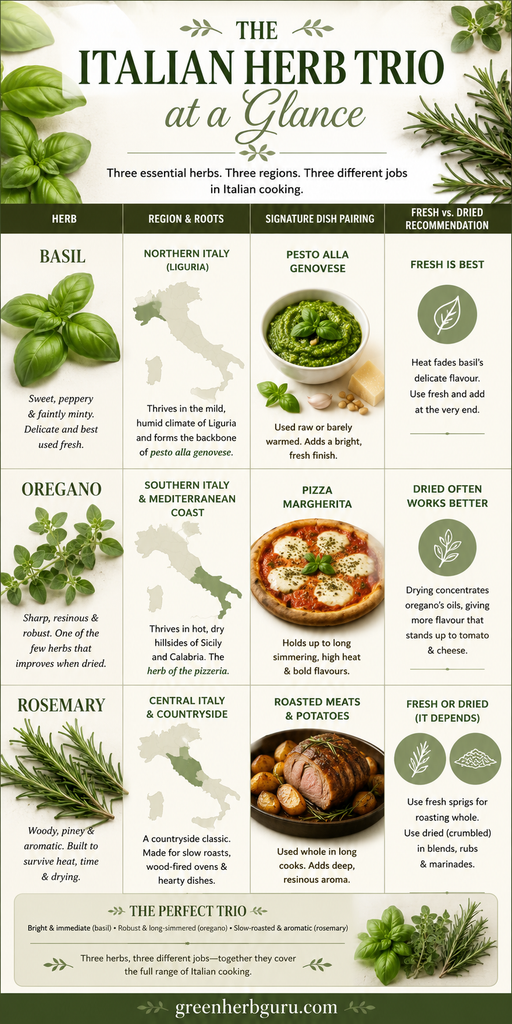
Oregano is a southern and Mediterranean-coast herb through and through, thriving in the hot, dry hillsides of Sicily and Calabria. Its flavour is sharper and more resinous than basil’s, and unusually for a leafy herb, it holds up well when dried, sometimes even improving as the leaves lose moisture and the oils concentrate. That’s a big part of why oregano became the herb of the pizzeria: consistent, shelf-stable and strong enough to stand up to tomato and melted cheese.
Rosemary sits apart from both, more a herb of the countryside kitchen than the coast, associated with slow-roasted meats, potatoes and the wood-fired ovens of central Italy. Its woody, piney character survives heat, time and drying better than almost any other Mediterranean herb, which is why it’s the one you’ll find tied into a bundle and simmered for hours rather than sprinkled on at the end.
Put together, the three cover the full range of Italian cooking: bright and immediate (basil), robust and long-simmered (oregano), and slow-roasted and aromatic (rosemary). Learning which is which does more for a home cook’s Italian repertoire than any single recipe.
🌿 Fresh vs. Dried: Why Oregano Breaks the Rule
The general rule for herbs is that fresh beats dried, but oregano is one of the genuine exceptions, and it’s worth understanding why before deciding which jar to reach for.
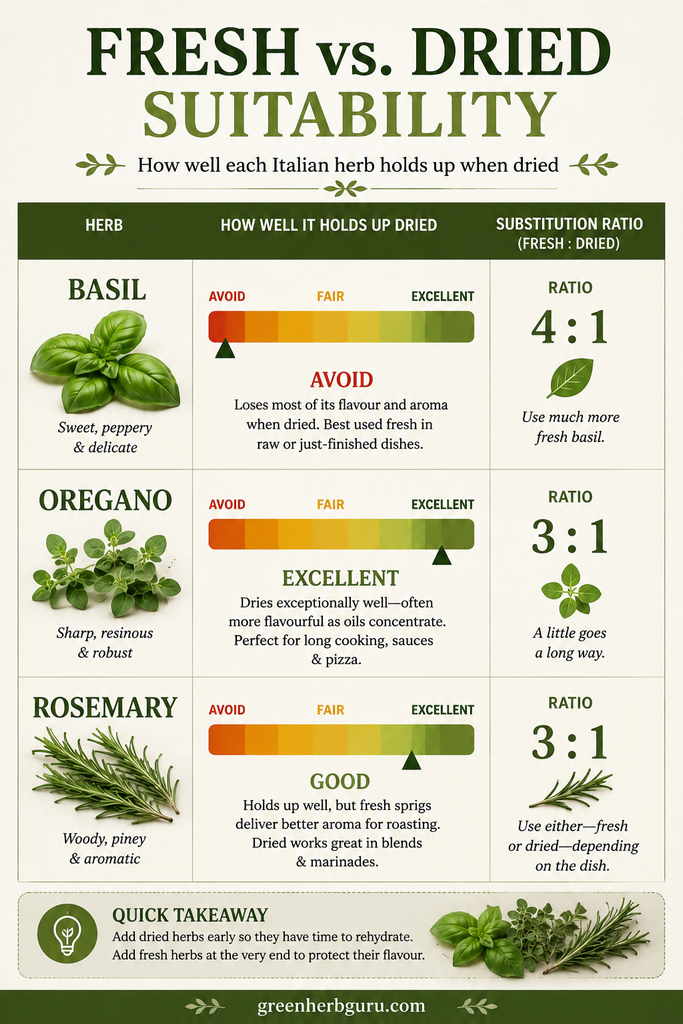
Basil follows the expected pattern. Its flavour lives in delicate volatile oils that fresh leaves hold and dried leaves largely lose, so dried basil tastes more like “green” than “basil.” If a recipe calls for fresh basil as a finishing touch, cold preparation or anything served within minutes of assembly, don’t substitute dried; there’s no good swap for what fresh basil does in a Caprese salad or stirred through pesto.
Oregano is the opposite case. Its oils are hardier, and drying concentrates rather than destroys them, which is genuinely why a lot of Italian and Italian-American cooking defaults to dried oregano even when fresh is available. For long-simmered tomato sauces, roasted vegetables or a pizza that’s about to go into a hot oven, dried oregano is not a compromise, it’s often the better choice. The full picture on how it grows and how the two forms compare is in the complete guide to oregano.
Rosemary lands somewhere between the two, more forgiving than basil but not quite as dried-friendly as oregano. Its woody structure means the oils are better protected than a soft leaf’s, so dried rosemary holds a real, recognisable flavour, but the texture turns brittle and needle-like, which is why cooks often reach for fresh sprigs when rosemary is going in whole for a roast, and dried when it’s being crumbled into a spice blend. More on that trade-off is in the full rosemary profile.
As a starting conversion: use roughly three parts fresh to one part dried for oregano and rosemary, but go closer to four parts fresh to one part dried for basil, since more of its character is lost in drying. Add dried herbs early, while there’s time for them to rehydrate in a sauce or braise; add fresh herbs at the very end, so the heat doesn’t cook away what makes them worth using fresh in the first place.
🍝 Classic Pairings That Built Italian Cuisine
Some herb-and-ingredient pairings are so established in Italian cooking that they’ve become shorthand for the dish itself.
Basil with tomato and mozzarella is the clearest example, the backbone of a Caprese salad and the finishing note on countless tomato sauces and a simple tomato basil soup. The pairing works because basil’s sweetness and pepperiness lift tomato’s acidity without competing with it, and both ingredients are at their best in the same warm months.
Oregano belongs with pizza and tomato sauce for a related reason: it’s assertive enough to come through a layer of melted cheese and a thick tomato base without disappearing. It’s also a defining note in a good homemade Italian seasoning blend, where its dried, concentrated flavour anchors the mix.
Rosemary’s signature pairing is roasted meat and potatoes, and there’s a genuine mechanical reason it works so well: rosemary’s oils are fat-soluble, so they infuse beautifully into the fat rendering off a roast or the oil coating potatoes going into a hot oven. A tray of rosemary garlic potatoes or a rosemary-studded roast both lean on that same principle: give the herb time and fat to work with, and it rewards you.
None of these pairings are arbitrary. Each one reflects the herb doing the specific job its flavour chemistry is best suited for, which is a useful lens for experimenting with other combinations, too.
🪴 Growing All Three on a Windowsill or Patio
Keeping fresh basil, oregano and rosemary on hand is more achievable than most beginner gardening guides suggest, but it helps to know that the three don’t quite want the same conditions, even though they’re often sold as a matching trio.
All three want plenty of direct light, ideally a south-facing windowsill or a sunny patio spot getting at least six hours of sun. Where they differ is water. Basil is thirsty and wants the top inch of soil to dry out between waterings, not much more, or the leaves will wilt and turn bitter. Rosemary is the opposite: it’s genuinely drought-tolerant and would rather the top two to three inches of soil dry out fully before its next drink, since soggy roots are the most common way to lose a rosemary plant. Oregano sits closer to rosemary, preferring to dry out a little between waterings rather than staying constantly moist.
The practical fix, if growing all three in the same container run, is to keep rosemary in its own pot with a fast-draining, gritty mix, and let basil have a slightly more moisture-retentive pot of its own. Oregano can go either way but tends to do better paired with rosemary’s drier routine than basil’s thirstier one. For the fuller planning picture, including spacing and pairing with other kitchen herbs, see the guide to planning a herb garden.
🧂 The Foundational Blend: Bringing All Three Together
Once you understand each herb’s role, the natural next step is a blend that uses all three in the ratio that reflects how they’re actually used in Italian cooking, not equal thirds. A workable base is roughly two parts dried oregano, one part dried basil and one part dried rosemary (crumbled fine, since whole needles are unpleasant to bite into), with a small amount of dried thyme or marjoram rounding it out if you have it.
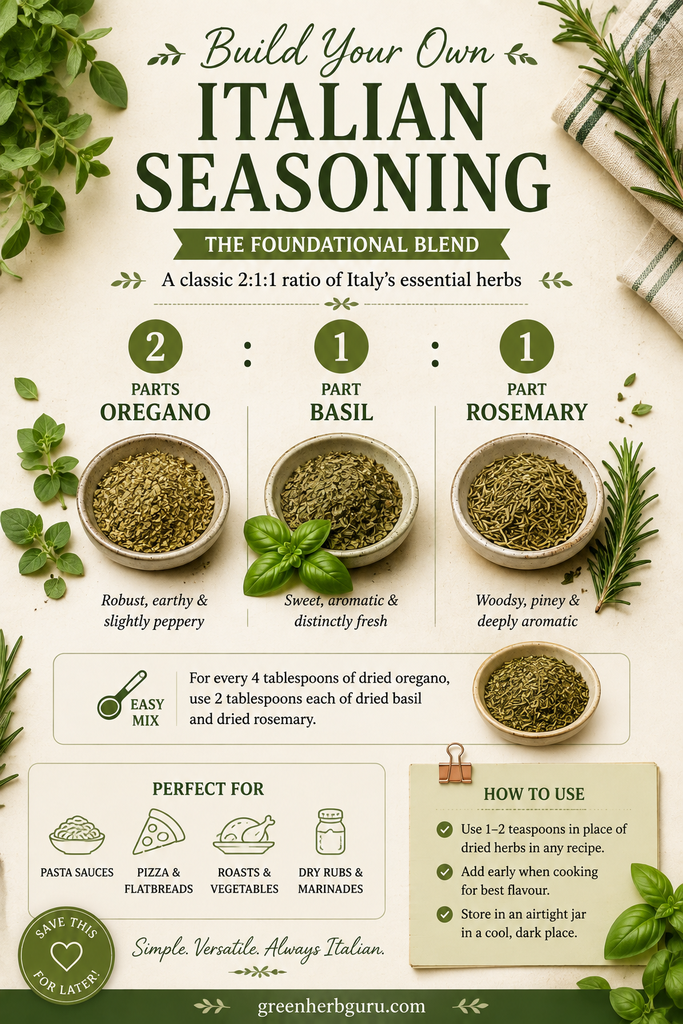
Oregano leads because it’s the most heat-stable and versatile of the three, doing the heavy lifting in sauces, roasted vegetables and marinades. Basil adds sweetness without dominating, and rosemary contributes a background resinous note that works well in meat rubs and roasted potato seasoning without overwhelming lighter dishes. This is essentially the logic behind a good homemade Italian seasoning mix: a blend built from herbs chosen for how they behave dried, not just how they taste fresh.
Keep the blend in a small jar near the stove for everyday use, and treat it as a starting formula rather than a fixed recipe. More rosemary if you’re seasoning a roast, more basil if the blend is finishing a fresh tomato dish rather than cooking into one.
🫙 Storing Each Herb the Right Way
Basil is the most fragile of the three in storage. Refrigeration actually damages the leaves, turning them black at the edges within a day, so fresh basil keeps best at room temperature with its stems in a glass of water, loosely covered, changed every couple of days. It rarely lasts more than a week even under good conditions, which is part of why it’s treated as a near-daily-use, buy-or-pick-fresh herb rather than one to stockpile.
Oregano and rosemary are far more forgiving. Fresh sprigs of either will keep for one to two weeks wrapped loosely in a damp paper towel in the fridge, and both dry well for long-term storage: hang small bunches somewhere warm and airy out of direct sun, or use a low oven or dehydrator for a faster result. For a full comparison of drying methods and how each holds up for different herbs, the complete guide to preserving fresh herbs covers the options in more depth than makes sense to repeat here.
However you dry them, the way you store the finished herbs matters almost as much as the drying method itself. Light, heat and air are what fade a dried herb fastest, so a set of dark or opaque, well-sealed glass storage jars kept in a cupboard rather than a rack beside the stove will noticeably extend how long oregano and rosemary hold their flavour, often well past the six-month mark where a loosely closed bag or a jar left in direct light would already be tasting flat.
❓ Frequently Asked Questions
Can I substitute dried oregano or rosemary for fresh in any recipe? For most cooked dishes, yes, using roughly three parts fresh to one part dried, and adding the dried version earlier in cooking so it has time to rehydrate. The exception is anything using the herb raw or as a last-minute garnish, where fresh is doing a job dried simply can’t replicate.
Why does dried oregano sometimes taste stronger than fresh? Drying removes water while concentrating the remaining volatile oils, and oregano holds onto more of those oils than most leafy herbs do. That’s why a pinch of dried oregano can taste more intense, spoonful for spoonful, than a much larger amount of fresh.
Can basil, oregano and rosemary really be grown in the same pot? They can, but it’s not the easiest option for a beginner, since basil wants noticeably more water than rosemary prefers. Separate pots, or at minimum separate zones within a large container, make it much easier to keep all three thriving rather than compromising on watering for all of them.
How long do dried Italian herbs actually stay usable? Most hold decent flavour for six months to a year in a cool, dark, airtight container. They won’t spoil the way fresh food does, but they’ll go quiet rather than pungent, so if a dried herb doesn’t smell like much when crushed between your fingers, it’s time to replace it.
A quick note on safety: this guide covers ordinary cooking amounts of basil, oregano and rosemary, which are considered safe for most people at typical culinary levels. Concentrated or therapeutic use of the same plants, such as strong herbal extracts, essential oils taken internally, or supplement-strength doses rather than a seasoning in a dish, is a different matter. If you’re pregnant, breastfeeding, taking medication, or cooking for very young children, check with a healthcare provider before treating any of these herbs as more than a seasoning.
Continue Your Journey
- Herbs Around the World: How Different Cuisines Use Fresh and Dried Herbs
- Planning Your Perfect Herb Garden: The Complete Guide
- Spice Uses and Substitutions: Savor and Save Your Recipes
- Multi-Herb Vinaigrettes and Dressings: One Ratio, Any Herb Glut
- Thyme: The Complete Guide to Growing, Cooking, and Using This Kitchen Essential
Want the next cuisine cluster the moment it lands? Pop your email in below and we’ll let you know as this series grows.


