Thai Basil: The Complete Guide to Growing, Cooking, and Using This Anise-Scented Southeast Asian Herb
Thai basil is the herb that makes a bowl of pho smell like pho. Rub a leaf between your fingers and you get a sweet, licorice-like perfume with a little spice behind it, nothing like the clove-and-pepper smell of the Italian basil on your pizza.
Most home cooks treat it as a niche ingredient, but it is one of the easiest and most useful herbs you can grow. It handles heat better than sweet basil, it looks lovely in a border or a pot, and a single plant will keep a household in stir fries and curries all summer.
As an Amazon Associate I earn from qualifying purchases and sometimes recommend products from other sellers at no extra cost to you. For more details see my disclosure policy and privacy policy.
What Is Thai Basil?
Thai basil is a variety of sweet basil. Its botanical name is Ocimum basilicum var. thyrsiflora.
Forged & Grown — The Shop
Handpicked products chosen to fit the way we cook, grow, and create. Nothing generic — every item earns its place.
Visit the Shop


It belongs to the mint family (Lamiaceae), alongside peppermint, lemon balm and the rest of the mint family. The genus name Ocimum comes from a Greek word meaning “to smell,” which tells you what people valued it for.
The plant is native to tropical Southeast Asia and is the basil most associated with Thai, Vietnamese, Laotian and Cambodian cooking. In Thai it is called horapha, and in Vietnam it is húng quế, a name that also gets applied to a few other basil types. You may also see it sold as anise basil or licorice basil, although those labels sometimes belong to separate Western cultivars.
Thai basil is compact and sturdy, usually reaching about 18 inches (45 cm). The leaves are narrow, glossy and slightly serrated, the stems are a deep purple, and the flower spikes are pink-purple. It looks like an ornamental plant, which is part of its charm.
It is technically a tender perennial, which means it would live for a couple of years in a frost-free climate. In most of the United States it is grown as an annual and treated as a summer crop.
Thai Basil, Holy Basil and Lemon Basil: Not the Same Thing
Thai cooking uses three main basils, and mixing them up is the most common mistake home cooks make. Thai basil (horapha) tastes of anise and licorice.
Holy basil (kaprao or gaprao, Ocimum tenuiflorum) is more peppery and clove-like, with fuzzier, more jagged leaves and hairy stems. Lemon basil (maenglak) is the citrusy one.
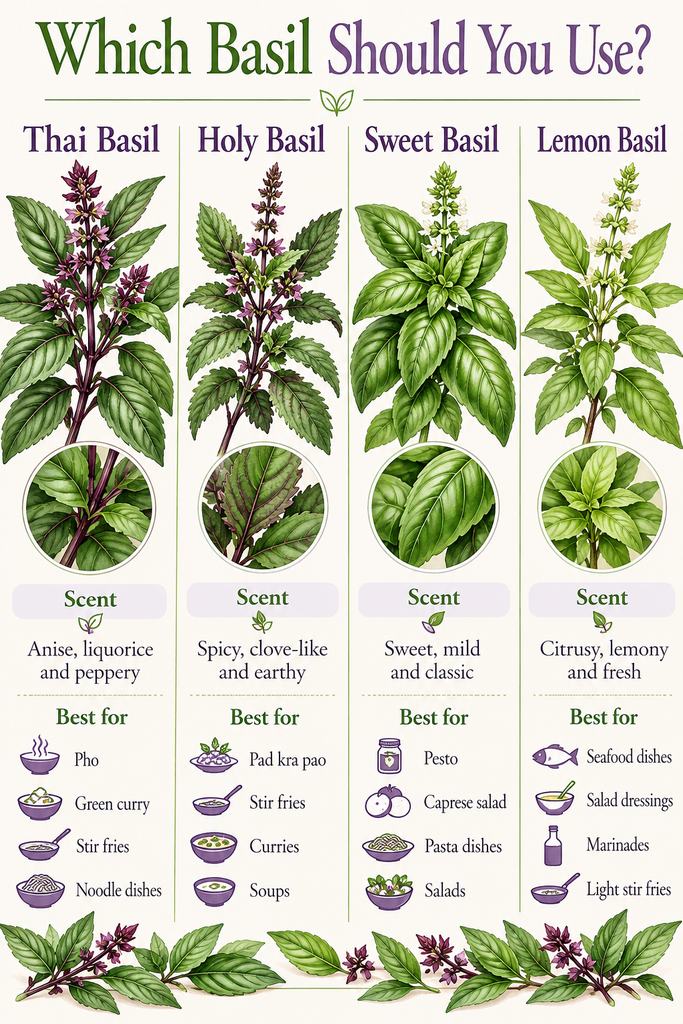
Here is the detail that surprises people. The famous Thai stir fry pad kra pao is traditionally made with holy basil, not Thai basil, which is why it is called “stir fried with holy basil.” If you cannot find holy basil, Thai basil is a perfectly good substitute and gives you a dish usually called pad horapha. It simply tastes different.
If you are curious about the wider family, our ultimate guide to basil covers the sweet basil most gardeners grow first.
A Short History
Basil in general is believed to have been cultivated first in India or tropical Asia and to have travelled west along the spice routes. Thai basil stayed closer to its roots and was selected over generations for its distinctive flavor and for how well it stands up to wok heat. That heat tolerance is a big reason it became a cornerstone of Southeast Asian cooking.
Common Varieties
When a nursery tag says “Thai basil,” you are usually getting one of a handful of cultivars. They are all close relatives, so you will not go far wrong with any of them.
Horapha is the classic. It is the plant most often sold simply as Thai basil, with the full anise and licorice scent, purple stems and tidy habit. If you want the authentic flavor, this is the one to look for.
Siam Queen is a popular named selection that is sold at many nurseries and seed companies. It stays around 12 to 18 inches tall, has the same narrow leaves and purple stems, and its flavor is often described as sweet and spicy with hints of anise, licorice and clove. It is also a good cut flower.
Thai Red has distinctly reddish stems and reaches roughly 18 inches. It is a handsome choice for ornamental plantings and cooks the same way as horapha.
Thai Sweet is sometimes listed as a cultivar that behaves as an annual, so check the seed packet if you hope to overwinter it indoors.
A few lookalikes are worth knowing about so you can read tags carefully.
- Cinnamon basil, also called Mexican spice basil, is sometimes confused with Thai basil and has a warmer, cinnamon-like note.
- Licorice basil has a similar anise flavor but is a separate cultivar. Some growers also call it Persian basil.
- Holy basil (tulsi) and lemon basil are different species and taste nothing like horapha.
If you are not sure what you have, crush a leaf.
Anise and licorice means Thai basil. Clove and pepper means holy basil. Lemon means, well, lemon basil.
Health Benefits
Basil, including Thai basil, has a long history in traditional medicine, and laboratory research has found antioxidant, anti-inflammatory and immune-modulating activity in its compounds. A published review of Ocimum basilicum lists compounds such as linalool, eugenol and rosmarinic acid among the plant’s key constituents. Most of that work was done on extracts and essential oils in cells and animals, not on people eating a few leaves in a curry.
That distinction matters. Studies on basil and its extracts in humans are limited, and larger, well-controlled trials are still needed. Some of the more promising human research involves holy basil rather than sweet or Thai basil, so it is a mistake to assume the results carry across.
What you can say with confidence is that Thai basil adds a lot of flavor for almost no calories or salt. If it helps you cook more fresh food at home, that is a real nutritional win, even without any medicinal claims attached.
Safety First
Eating basil as a food is considered safe for most people, including during pregnancy and breastfeeding. The picture changes with concentrated forms.
Basil and its essential oil contain estragole (also called methyl chavicol), which has caused liver tumors in laboratory mice, and which the NIH’s lactation database describes as a possible procarcinogen. Many sources recommend avoiding medicinal doses of basil during lactation because of that estragole content and the lack of safety data, as noted in the LactMed entry on basil.
Estragole is generally linked to the anise-like note in Thai basil, so this is a good reason to keep Thai basil in the kitchen as a culinary herb rather than a supplement. Skip basil essential oil taken by mouth and concentrated extracts unless a healthcare provider has cleared them.
People taking blood pressure medication or anticoagulant or antiplatelet drugs should also be cautious with basil extracts and oils, since they may add to those drugs’ effects. Normal cooking amounts are a different matter, but if you are on these medications and plan to use basil medicinally, talk to your doctor or pharmacist first. Our guide to herbal tea safety explains how to think about herbs and medications more broadly.
How to Grow Your Own Thai Basil
Thai basil is a warm-weather plant that grows fast once the weather settles. Give it sun, warmth and decent drainage, and it will reward you quickly.
Sunlight
Plant it in full sun, which means at least six hours a day, although it tolerates some afternoon shade in hot climates. Indoors, a south-facing window or a grow light is the best bet.
Soil
Thai basil likes well-drained, loamy soil enriched with compost. Heavy, waterlogged soil is the fastest way to lose a plant, so add grit or choose a raised bed if your ground is clay.
Water
Water deeply when the top inch of soil feels dry, and let the pot or bed drain. Basil grown in containers needs water more often than basil in the ground. A self-watering pot takes a lot of the guesswork out of this, especially in midsummer.
Temperature and Timing
Thai basil is not frost hardy and dislikes cold. Growth slows and stalls once temperatures fall below about 59°F (15°C), so do not sow or transplant until nights are reliably warm.
Start seeds indoors about six weeks before your last frost date, or buy young plants once the weather has warmed. Seeds typically sprout within about ten days. They need light to germinate, so press them onto the surface of the mix and barely cover them.
Space plants 12 to 18 inches apart outdoors, and pot them into a container at least 8 to 10 inches wide.
Feeding
A light feed with a balanced fertilizer or a top-dressing of compost every few weeks during the growing season keeps the leaves coming. Too much nitrogen can give you lots of leaf with less flavor, so go easy.
Pinching and Pruning
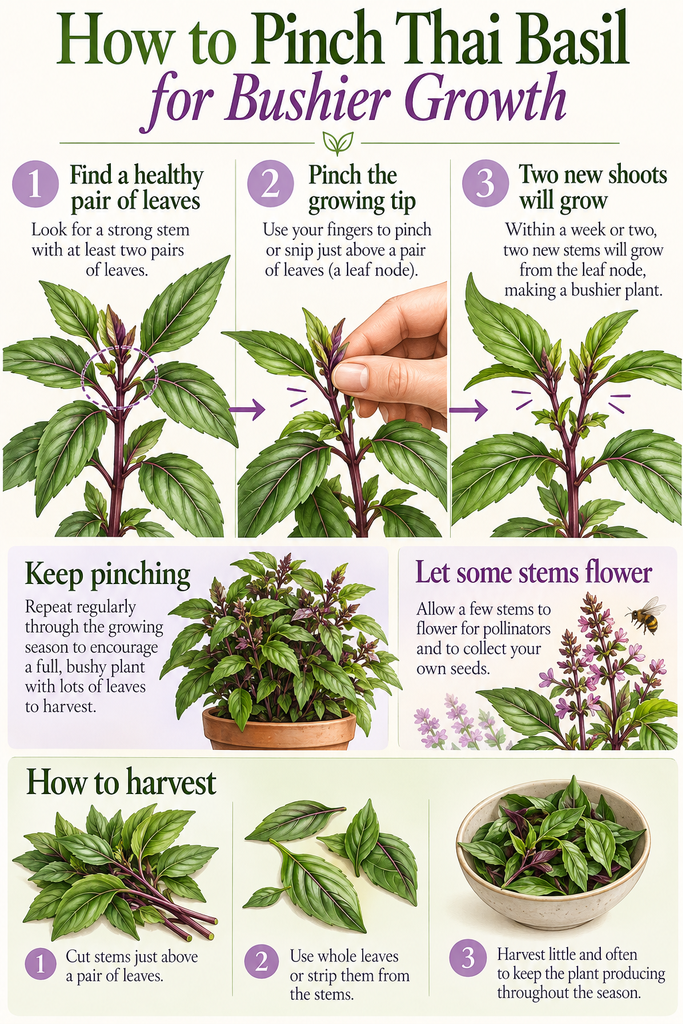
This is the secret to a bushy plant. Pinch out the growing tips regularly, cutting just above a pair of leaves, so the plant branches instead of racing upward.
When flower spikes form, pinch those off too if you want the most leaves. Left alone, the plant puts its energy into flowering and seeds, and the foliage gets smaller and slightly bitter. That said, the pink-purple blooms are edible and look beautiful in salads, so let one stem flower at the end of the season if you like.
Common Problems
- Black or brown patches on leaves. Usually cold damage or fungal disease. Keep leaves dry, avoid overhead watering in the evening, and never chill the plant.
- Yellowing leaves. Often overwatering or poor drainage. Check the root zone and let it dry slightly.
- Leggy growth. Not enough light or not enough pinching.
- Holes and chewed leaves. Slugs, snails, aphids and caterpillars all enjoy basil. Pick them off by hand or rinse aphids away with a jet of water.
- Sudden wilting. Check for downy mildew and root rot. Remove affected plants rather than composting them.
Indoor vs Outdoor Growing
Thai basil is a good indoor herb as long as it gets light and warmth. A sunny windowsill works from spring through fall, and a grow light carries it through winter. Our guides to kitchen herb micro-gardens and the October herb garden jobs cover how to move tender herbs indoors before the first frost.
If you want to carry a favorite plant through winter, take cuttings in late summer. Four-inch stem tips root readily in a glass of water, and our guide to regrowing herbs from cuttings walks through the method.
Tips for Success
- Wait until the weather is properly warm before planting out.
- Harvest little and often rather than stripping the plant in one go.
- Never remove more than about a third of the plant at once.
- Grow a second plant from cuttings in late summer as insurance for winter.
Basic Usage Guide
Flavor Profile
Thai basil tastes of anise and licorice with a touch of mint and a gentle peppery heat. Its flavor is sturdier than sweet basil’s and survives high heat and longer cooking, which is why it turns up in curries and stir fries rather than only as a last-minute garnish.
Parts of the Plant You Can Use
The leaves are the main event. Tender stems and the pink-purple flower buds are edible too, and the flowers make a pretty garnish. Tough lower stems are best saved for infusing stocks and syrups.
Best Preparation Methods
- Tear, do not chop. Tearing by hand bruises the leaves less than a knife and keeps them from blackening.
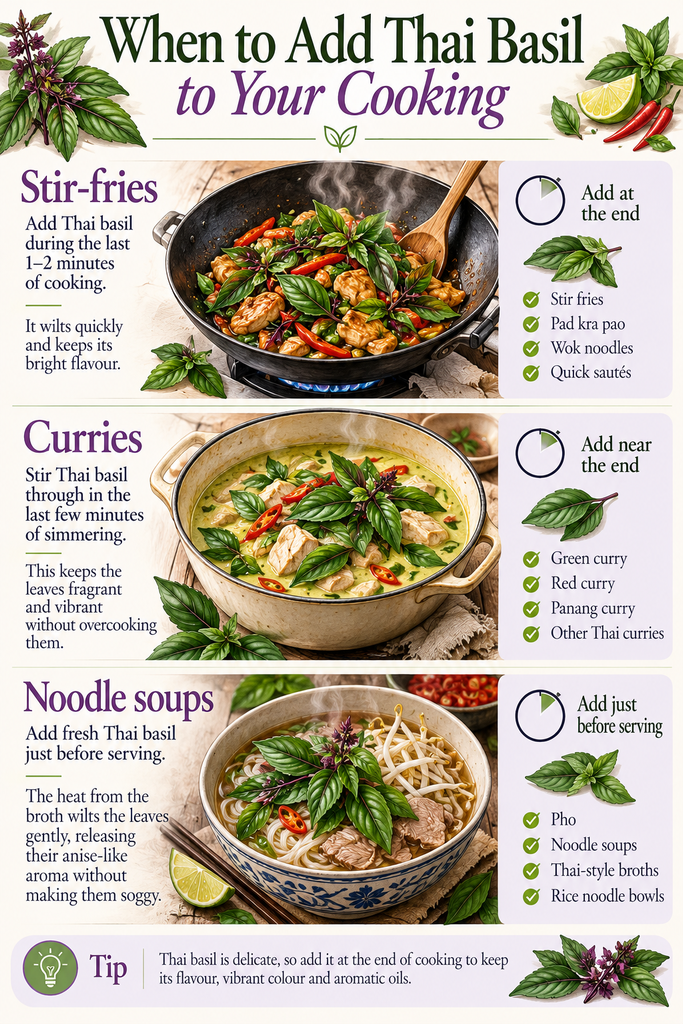
- Add it late for freshness. Stir leaves in during the final minute of cooking for the strongest aroma.
- Serve it raw as well. In Vietnam and northern Thailand a plate of whole fresh leaves is often served alongside noodle soups, so each person can tear some into the bowl.
- Use it generously. Thai basil is often added by the handful, not the pinch.
Common Pairings
Thai basil loves lime, chili, garlic, ginger, fish sauce, coconut milk and lemongrass. It sits comfortably next to cilantro and mint in herb plates, and it works with chicken, pork, beef, tofu, eggplant, shrimp and fish. If lemongrass is new to you, try our lemongrass growing and cooking guide, and for the other classic herb in those dishes see growing your own cilantro.
Tips for Maximizing Flavor
Pick leaves in the morning when the oils are strongest, and use them quickly, because fresh Thai basil loses flavor fast. Add a handful at the end of cooking, and keep a few leaves back to scatter on top.
Thai basil is also a natural fit for a Southeast Asian herb bed, with lemongrass, mint and cilantro growing alongside it. For a wider look at how herbs fit into different cooking traditions, see our guide to herbs around the world, and if you are planning ahead, our herb garden planning guide helps you decide what goes where.
Recipe Ideas
These four ideas use Thai basil in different ways, from a weeknight dinner to a drink.
1. Thai Basil Chicken Stir Fry (Pad Horapha)
This is the easy gateway recipe. It uses the same flavors as pad kra pao but with Thai basil.
Ingredients: 1 lb (450 g) ground or finely sliced chicken, 4 garlic cloves, 2 to 4 Thai chilies, 2 tablespoons oyster sauce, 1 tablespoon soy sauce, 1 teaspoon sugar, 1 tablespoon neutral oil, 1 large handful Thai basil leaves, and steamed rice to serve.
Method: Pound the garlic and chilies into a rough paste. Heat the oil in a wok until it shimmers, fry the paste for 20 seconds, then add the chicken and stir fry until cooked through. Add the sauces and sugar, toss for a minute, then take the pan off the heat and fold in the basil so it wilts but keeps its color. Serve over rice, ideally with a fried egg on top.
2. Vietnamese Herb Plate for Pho
This is not so much a recipe as a way of serving. Pile a plate with whole Thai basil leaves, mint, cilantro, bean sprouts, lime wedges and sliced chili. Everyone tears and adds their own to hot noodle soup, so the herbs stay fresh and the flavor changes with every spoonful.
3. Thai Basil Pesto
Swap it into your favorite pesto for something more interesting.
Blend 2 packed cups of Thai basil leaves with 1/3 cup roasted cashews or peanuts, 2 garlic cloves, the juice of one lime, 1/3 cup olive oil and a splash of fish sauce or a pinch of salt until you have a loose paste. Toss it through rice noodles, spoon it over grilled fish, or stir it into a stir fry. For the classic Italian version, see our homemade pesto recipe.
4. Thai Basil Lemonade
Simmer 1 cup of water with 1 cup of sugar and a big handful of Thai basil leaves for five minutes, then steep for 20 minutes and strain. Mix 1/4 cup of that syrup with the juice of two lemons and cold sparkling water over ice, and add a fresh sprig to each glass. The anise note makes it taste distinctly different from regular basil lemonade.
Cooking Tips and Techniques
- Always add Thai basil at the end of cooking unless you want a mellow, background flavor.
- Wok cooking suits it perfectly because it tolerates fierce heat better than Italian basil.
- For curries, stir in a handful just before serving and a few more on top.
- Wash and dry leaves thoroughly. Wet leaves steam instead of sizzling.
Storage Methods
Fresh Thai basil does not like the cold, so the fridge is not its friend. Cold air turns the leaves black and speckled within a day or two.
Fresh Storage
Trim the stem ends and stand the bunch in a glass of water on the counter, away from direct sun, like a bouquet. Change the water every day or two. It will usually stay fresh for about a week this way.
If you must refrigerate it, wrap the stems in a damp paper towel, tuck the bunch into a loosely closed bag and keep it in the warmest part of the fridge, which is usually a door shelf. Use it within a few days.
Freezing
Freezing preserves much more flavor than drying.
Chop the leaves, pack them into an ice cube tray, top with olive oil or water and freeze, then transfer the cubes to a bag. Drop a cube straight into a curry or stir fry. Our guide to freezing fresh herbs shows several variations, including herb butter logs.
Drying
Thai basil loses most of its distinctive anise character when dried, so treat dried leaves as a pantry backup rather than a replacement.
If you want to try it, hang small bunches in a warm, airy place or use a dehydrator. Our comparison of air-drying, dehydrator and oven methods explains which works best, and the broader guide to preserving fresh herbs covers all the options. Once dried, check the shelf life of dried herbs so you know when to replace them.
Signs of Spoilage
Throw leaves away if they are slimy, smell sour or musty, or have spreading black patches. A few darkened edges from cold are harmless if the leaf is otherwise firm and fragrant. Faded, flavorless leaves are not dangerous, but they are not worth cooking with either.
Frequently Asked Questions
Is Thai basil the same as sweet basil?
No. Both are Ocimum basilicum, but Thai basil is a distinct variety with narrower leaves, purple stems, and an anise and licorice flavor. Sweet basil is milder, sweeter and more clove-like, and it wilts quickly in high heat.
Can I substitute Thai basil for regular basil?
Yes, but expect a different flavor. Thai basil works in some Italian-style dishes, though its anise note will stand out. Going the other way, sweet basil will work in Thai recipes but will taste sweeter and lose its flavor faster in the wok.
Is Thai basil the same as holy basil?
No. Holy basil (Ocimum tenuiflorum, or tulsi) has a clove-like, peppery taste and fuzzy, serrated leaves. It is the traditional herb for pad kra pao, and Thai basil is a workable substitute when you cannot find it.
Is Thai basil a perennial?
It is a tender perennial, so it lives for a couple of years in frost-free climates. Most gardeners grow it as an annual because it cannot survive frost, though you can overwinter it indoors with plenty of light.
Can I grow Thai basil indoors?
Yes. Give it at least six hours of bright light or a grow light, keep it warm, and avoid cold drafts. Pinch regularly to keep it bushy.
Why is my Thai basil flowering?
Basil flowers as it matures, especially in heat or when it is stressed. Pinch off flower spikes to encourage more leaf growth, or let a few flower for the pollinators.
Why are my Thai basil leaves turning black?
The usual cause is cold. Temperatures near or below 50°F (10°C), including from a refrigerator, can damage the leaves. Fungal disease from wet foliage is the second most common cause.
Can I eat Thai basil flowers?
Yes. The pink-purple blossoms are edible and carry a milder version of the leaf flavor. They make a pretty garnish for salads and noodle bowls.
Is Thai basil safe during pregnancy?
Normal culinary amounts are generally considered fine. Concentrated extracts, supplements and essential oils are a different matter because of the estragole they contain, so ask your healthcare provider before using basil medicinally.
Where can I buy Thai basil?
Many grocery stores and Asian markets sell fresh bunches, and garden centers carry plants in spring and summer. Seeds are widely available online, and growing your own is usually cheaper than buying it by the bunch.
Conclusion
Thai basil earns its place in the herb garden because it gives you something no Italian basil can. Its anise-scented leaves hold their flavor in hot woks, perfume curries and noodle soups, and look good doing it.
Start with one plant in a sunny pot, pinch it often, and use the leaves generously and late in cooking. Next time a recipe calls for a handful of basil, reach for this one and see how much a single herb can change a dish.
Continue Your Journey
- Lemongrass: The Complete Guide to Growing, Cooking, and Using This Citrusy Southeast Asian Herb
- Herbs Around the World: How Different Cuisines Use Fresh and Dried Herbs
- Italian Herbs: Basil, Oregano, Rosemary and the Foundations of Italian Cooking
- Your Herb Garden Calendar: A Month-by-Month Growing and Care Guide
- How to Make Basil Tea at Home
Want more herb guides like this one in your inbox? Join the Green Herb Guru newsletter for seasonal growing tips, safe-and-simple herb recipes, and new guides as they publish.


