Bay Leaf: A Complete Guide to Growing, Cooking, and Storing This Kitchen Staple
Bay leaf sits in almost every spice rack, yet most cooks only know it as the mystery leaf they fish out of soup before serving. That’s a shame, because bay leaf is one of the easiest herbs to grow indoors year-round, and its flavor contribution goes far beyond “vaguely herby.” Once you understand what bay actually does in a dish, and how simple the plant is to keep alive, it stops being an afterthought and becomes one of the more useful plants in your kitchen garden.
This guide covers where bay leaf comes from, how to tell true bay from its look-alikes, what the research says about its health benefits, how to grow your own plant, and how to store leaves so they hold onto flavor for years.
As an Amazon Associate I earn from qualifying purchases and sometimes recommend products from other sellers at no extra cost to you. For more details see my disclosure policy and privacy policy.
What Is Bay Leaf?
Bay leaf comes from Laurus nobilis, an evergreen shrub or small tree in the Lauraceae family, the same family that gives us cinnamon and avocado. It’s native to the Mediterranean basin, where it still grows wild across coastal hillsides in Greece, Turkey, and southern Italy.
Forged & Grown — The Shop
Handpicked products chosen to fit the way we cook, grow, and create. Nothing generic — every item earns its place.
Visit the Shop


The plant has a long history that predates its use as a seasoning. In ancient Greece, laurel wreaths made from bay branches crowned victors at the Pythian Games, and the word “laureate,” as in poet laureate, traces directly back to this tradition. Romans planted bay trees near their homes as a symbol of protection and honor.
Bay is closely related to a handful of other aromatic laurel-family plants, though most of those relatives aren’t used in cooking. California bay laurel (Umbellularia californica) is a different species entirely with a much sharper, more medicinal flavor, and it’s not a direct substitute in recipes calling for true bay.
Across cultures, bay leaf shows up in remarkably similar ways: as a background aromatic simmered in liquid rather than eaten directly. French cuisine leans on it as a core component of the bouquet garni. Indian cooking uses a related but distinct leaf, tej patta, in biryanis and curries. Mediterranean and Middle Eastern kitchens add it to stews, braises, and pickling brines. For a broader look at how different food traditions build flavor with herbs, see our guide to herbs around the world.
Common Varieties
Home cooks and gardeners generally encounter three types of “bay leaf,” and knowing the difference matters for both flavor and safety.
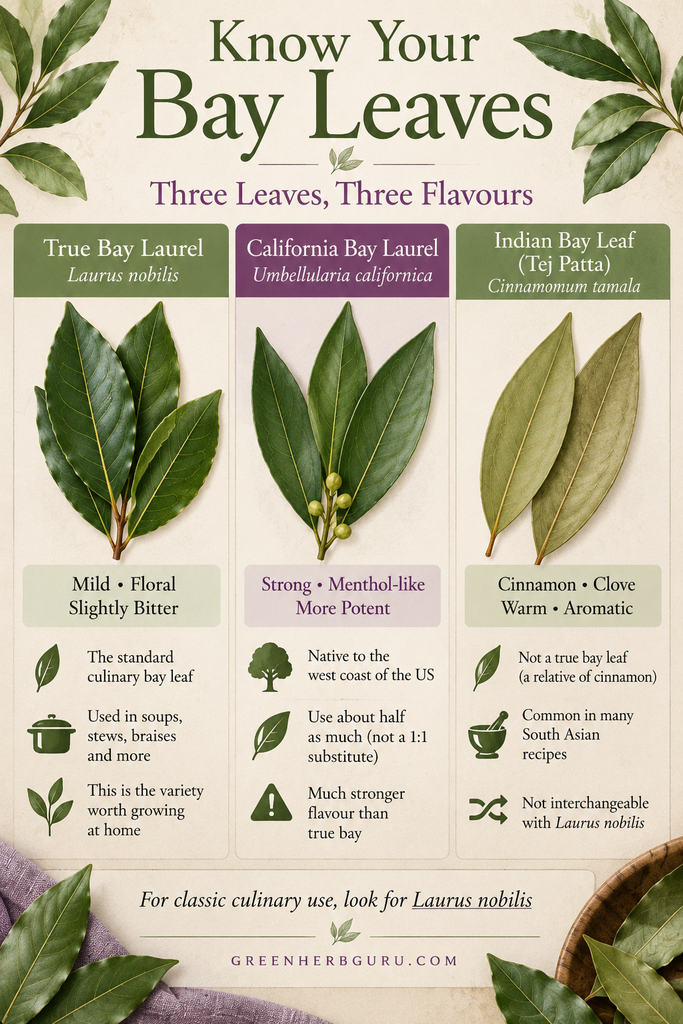
True Bay Laurel (Laurus nobilis) This is the standard culinary bay leaf sold in grocery stores. It has a mild, slightly floral, slightly bitter flavor that mellows and deepens the longer it simmers. This is the variety worth growing at home.
California Bay Laurel (Umbellularia californica) Native to the West Coast of the United States, this leaf is significantly more potent and has a menthol-like sharpness. If you’re picking leaves from a wild tree in California or Oregon, don’t substitute it 1:1 for Laurus nobilis in a recipe. Use about half as much.
Indian Bay Leaf / Tej Patta (Cinnamomum tamala) Despite the name, this isn’t a true bay leaf at all. It’s actually a relative of cinnamon, with a flavor closer to clove and cinnamon bark than to Mediterranean bay. It’s essential in many South Asian recipes but isn’t interchangeable with Laurus nobilis.
For garden purposes, look for Laurus nobilis specifically at nurseries, and check that the label doesn’t say “California bay” or “Indian bay” if you want the classic culinary variety. If you’re ever out of bay entirely, our spice uses and substitutions guide covers reasonable stand-ins for a pinch.
Health Benefits
Bay leaf has a long history in traditional medicine, and modern research has started to catch up with some of those traditional uses, though the evidence base is still developing.
Digestive support. Bay leaf has traditionally been used to ease bloating and support digestion, and some laboratory research on its essential oil compounds suggests anti-inflammatory and antimicrobial properties that could plausibly support gut health. Most of this research is preliminary and conducted on extracts or essential oils rather than the whole leaf used in cooking. Bay is one of several everyday kitchen herbs covered in our beginner’s guide to medicinal herbs you can grow in pots.
Antioxidant content. Bay leaves contain compounds like linalool, eucalyptol, and catechins, which have antioxidant activity in laboratory studies. The National Center for Complementary and Integrative Health notes that many culinary herbs contribute meaningful antioxidant compounds to the diet even in small quantities. See our roundup of herbs and spices that may help reduce inflammation for how bay compares to other kitchen staples.
Blood sugar research. A small body of research has looked at bay leaf’s effect on blood glucose markers, with some early studies suggesting a modest supportive role as part of an overall healthy diet. This research is not conclusive, and bay leaf should never be treated as a substitute for prescribed diabetes management. Anyone managing blood sugar with medication should talk to their doctor before using bay leaf supplements or concentrated extracts, since herbs can interact with medications.
Respiratory comfort. Traditional use includes steaming with bay leaves to ease congestion, likely related to the same aromatic compounds found in eucalyptus and rosemary. There isn’t strong clinical evidence for this specific use, but it’s a low-risk traditional practice for otherwise healthy adults.
A note on safety: whole bay leaves are tough and don’t soften fully even after long cooking. They should always be removed from a dish before serving, since an intact leaf can be a choking hazard or cause minor internal scratching if swallowed. Ground bay leaf powder doesn’t carry this risk and can be left in a finished dish.
Pregnant women, people on blood-thinning medication, and anyone with a known allergy to Lauraceae-family plants should check with a healthcare provider before using bay leaf beyond normal culinary amounts.
How to Grow Your Own
Bay laurel is one of the more forgiving herbs you can grow, and it’s an excellent container plant if you don’t have garden space.
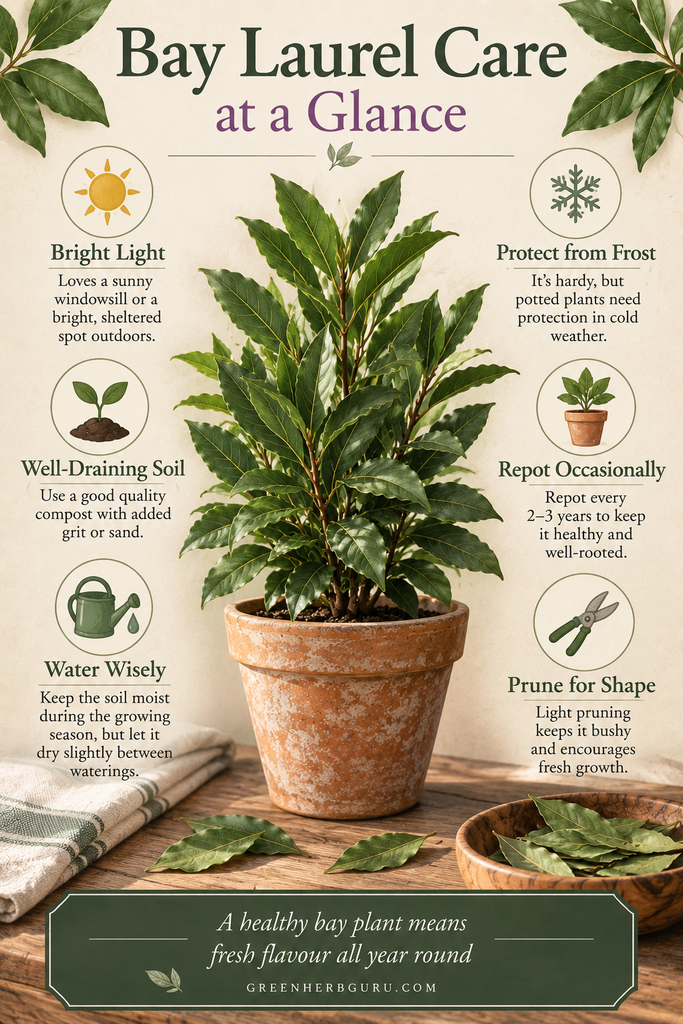
Sunlight. Bay prefers full sun to partial shade. Indoors, place it near your brightest window, ideally south-facing. It tolerates lower light better than many Mediterranean herbs, which makes it a good candidate for apartment growing.
Soil. Well-draining soil is essential. A standard potting mix with added perlite or coarse sand works well. Bay laurel is sensitive to waterlogged roots, so drainage matters more than soil richness.
Water. Let the top inch or two of soil dry out between waterings. Bay is more drought-tolerant than most kitchen herbs and is far more likely to suffer from overwatering than underwatering.
Temperature. Bay laurel is hardy outdoors in warmer climates but needs winter protection anywhere temperatures regularly drop below freezing. Container growing lets you move the plant indoors before the first frost.
Growing season and pace. Bay is a slow grower compared to annual herbs like basil. It can take two to three years to establish a plant large enough for regular harvesting, which is one reason most home cooks start with a nursery plant rather than seed.
Common challenges. Scale insects and spider mites are the most frequent pest issues, especially on indoor plants. Check the undersides of leaves periodically and wipe them down with a damp cloth if you notice sticky residue or webbing. Yellowing leaves usually point to overwatering rather than a nutrient deficiency.
Indoor vs. outdoor. Bay laurel adapts well to container life indoors year-round if you don’t have a Mediterranean-style climate, making it a solid pick for a windowsill herb setup. Outdoors, it can eventually grow into a substantial shrub or small tree, so plan for size if you’re planting in the ground rather than a pot.
A few basic gardening tools make container care noticeably easier, from a well-fitted pot to a moisture meter that takes the guesswork out of watering.
Tips for success. Repot every two to three years as the plant grows, moving up one container size at a time. Light, occasional pruning encourages a fuller shape and gives you a steady supply of leaves without stressing the plant.
Basic Usage Guide
Flavor profile. Fresh bay leaf has a green, slightly bitter, almost menthol-like sharpness. Dried bay leaf mellows considerably, developing a warmer, more rounded, faintly floral flavor that’s less aggressive than the fresh version. Most recipes are actually written with dried bay in mind.
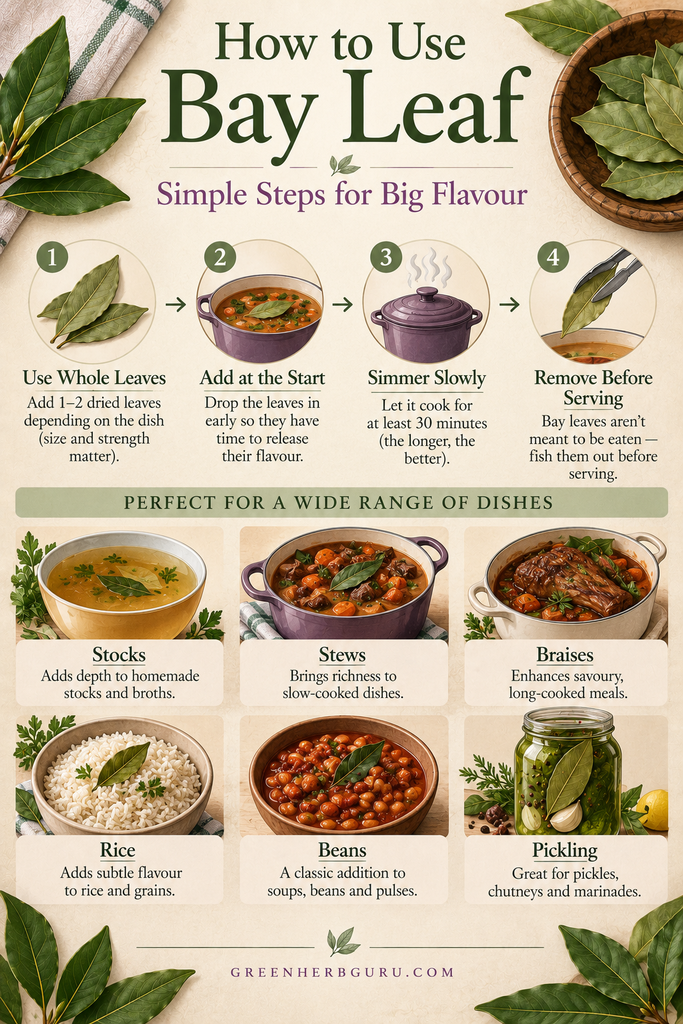
Culinary applications. Bay leaf is almost always used whole and removed before serving, added early in the cooking process to infuse liquid over time. It rarely works as a last-minute addition since its flavor needs sustained heat to release.
Parts of the plant used. Only the leaves are used in cooking. The berries and other parts of the plant are not used culinarily and shouldn’t be consumed.
Common combinations. Bay leaf pairs naturally with thyme and parsley in a classic bouquet garni, and works well alongside peppercorns, garlic, onion, and root vegetables in long-simmered dishes. It shows up in stocks, braises, marinades, pickling brines, rice dishes, and legume pots.
Best preparation methods. Add whole dried leaves at the start of simmering, braising, or slow cooking. For a subtler background note, toast a leaf briefly in oil before adding other aromatics. Always remove leaves before serving.
Tips for maximizing flavor. Crack or lightly crush a dried bay leaf before adding it to release more of its essential oils. Store leaves whole rather than crumbled until you’re ready to use them, since crumbled leaf loses aroma faster.
Recipe Ideas
Classic Bay-Infused Chicken Stock Simmer chicken bones, onion, carrot, celery, two bay leaves, and a few peppercorns for several hours. The bay leaf builds a savory backbone that makes the stock taste rounder without contributing an identifiable flavor on its own.
Braised White Beans with Bay and Garlic Cook dried white beans low and slow with olive oil, whole garlic cloves, a bay leaf or two, and a splash of stock until creamy. This is one of the clearest demonstrations of what bay actually does, since the dish is simple enough to taste the difference with and without it.
French-Style Bouquet Garni Tie a bay leaf, a few sprigs of thyme, and parsley stems together with kitchen twine. Drop the bundle into soups, stews, or braises and pull it out whole at the end. This is the traditional French method and makes removal effortless.
Spiced Rice Pilaf Toast rice briefly in butter with a bay leaf, a cinnamon stick, and whole cardamom pods before adding stock. The bay leaf adds a subtle savory layer that balances the warmer spices.
Storage Methods
Fresh storage. Fresh bay leaves keep for one to two weeks wrapped loosely in a damp paper towel inside the refrigerator’s crisper drawer.
Drying. Bay leaves dry easily. Lay leaves in a single layer on a paper towel or drying rack in a cool, dark spot for one to two weeks, or use a dehydrator on a low setting for a faster result. Our comparison of air-drying, dehydrator, and oven-drying methods breaks down which approach suits bay best if you’re drying a larger batch.
For the full range of preservation options beyond drying, our complete guide to preserving fresh herbs covers freezing and infusing methods that work well alongside bay.
Long-term storage. Store dried bay leaves whole in an airtight container away from direct light and heat. Whole leaves hold their aroma far longer than crushed or ground bay, often for one to two years compared to just a few months for pre-crushed leaf.
Freezing. Fresh bay leaves can be frozen flat in a sealed bag for up to six months, though most cooks find drying more practical since bay is typically used dried anyway.
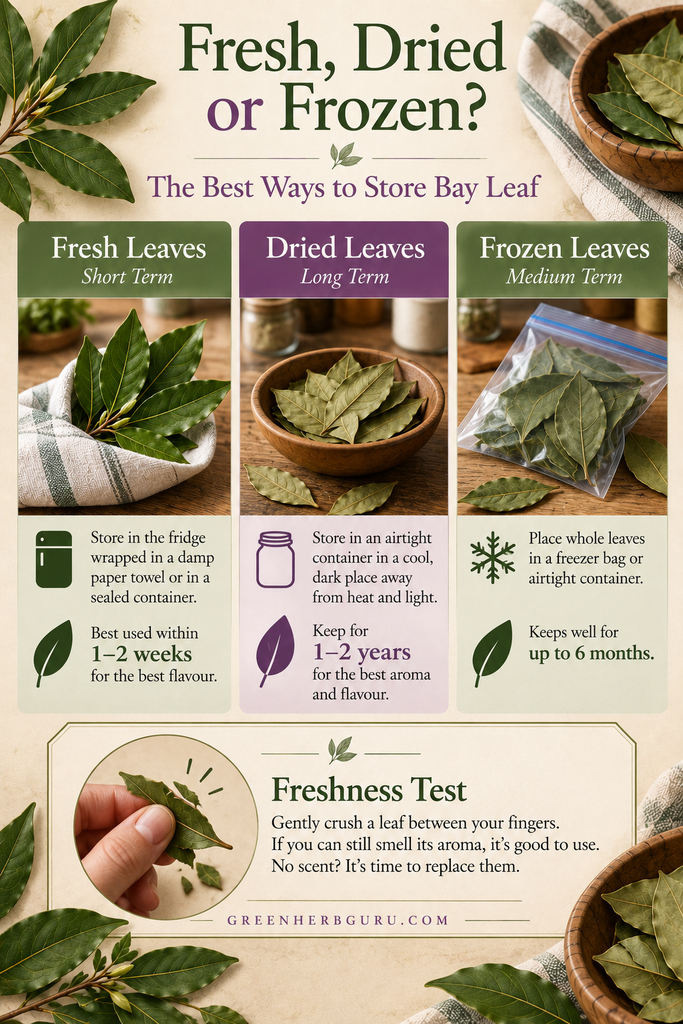
Signs of spoilage. Dried bay leaves don’t spoil in the traditional sense, but they do lose potency. A leaf that’s lost its aroma when crushed between your fingers is past its useful life and should be replaced, even if it looks fine visually.
Frequently Asked Questions
Is it safe to eat a bay leaf if I accidentally swallow it in soup? A single small piece is unlikely to cause serious harm, but whole bay leaves are stiff and can scratch the throat or digestive tract, or in rare cases lodge in the esophagus. Always remove whole leaves before serving, and if you experience pain or difficulty swallowing after accidentally ingesting one, seek medical attention.
Can I substitute dried bay leaf for fresh, or the other way around? Yes, but adjust the amount. Fresh bay is sharper, so use about half as much fresh as the dried amount called for in a recipe, and expect a more assertive, slightly bitter edge.
Why does my dish taste like nothing changed after adding bay leaf? Bay works subtly and needs time. A quick 10-minute simmer won’t extract much flavor. Dishes that cook for 30 minutes or longer, like stocks, braises, and stews, show its contribution far more clearly.
Can I grow bay laurel from a leaf or cutting instead of buying a plant? Bay can be propagated from stem cuttings, though it’s slow and has a lower success rate than herbs like basil or mint. Most home growers find it faster and more reliable to start with a young nursery plant.
Is California bay laurel safe to use in the same recipes as Mediterranean bay? It’s safe for most people in small amounts, but it’s significantly more potent and has a sharper, more medicinal flavor. Use roughly half the quantity called for if substituting California bay for Laurus nobilis, and taste as you go.
Do bay leaf trees produce anything else useful, like berries or oil? Bay trees do produce small dark berries, but they aren’t used in home cooking. Bay laurel essential oil is extracted commercially from the leaves and is used in some traditional and aromatherapy applications, though that’s a separate product from cooking with the leaf itself.
How many bay leaves should I use in a typical recipe? Most stocks, stews, and braises call for one to three leaves depending on batch size. More isn’t necessarily better, since bay’s flavor can turn slightly medicinal or bitter in large quantities.
Can I keep a bay laurel plant small permanently, or will it always outgrow a pot? Bay laurel tolerates pruning well and can be kept as a compact tabletop plant indefinitely with regular trimming. Many home cooks maintain it as a small, shaped plant specifically for this reason.
Conclusion
Bay leaf earns its place in the pantry through patience rather than intensity. It won’t announce itself the way garlic or chili does, but pull it out of a long-simmered stew and the difference is obvious. Growing your own is a low-maintenance way to always have fresh leaves on hand, and understanding the difference between true bay and its look-alikes means you’ll get the flavor a recipe actually intends. Once you’ve tasted a stock built with real bay leaf, going back to a bay-less version feels like something’s missing.
Continue Your Journey
Explore more herb profiles and grow your kitchen garden further:
- Oregano: The Complete Guide to Growing, Cooking, and Using This Mediterranean Staple
- Sage: A Complete Guide to Growing, Cooking, and Using This Garden Classic
- Thyme: The Complete Guide to Growing, Cooking, and Using This Kitchen Essential
- Tarragon: The Complete Guide to Growing, Cooking, and Using This French Kitchen Essential
- Italian Herbs: Basil, Oregano, Rosemary and the Foundations of Italian Cooking
Never miss a new herb profile or growing guide. Subscribe to the Green Herb Guru newsletter for fresh tips delivered straight to your inbox.